

Child Screen Time by Age: How Much Is OK and How to Cut Phone Habits

At a glance
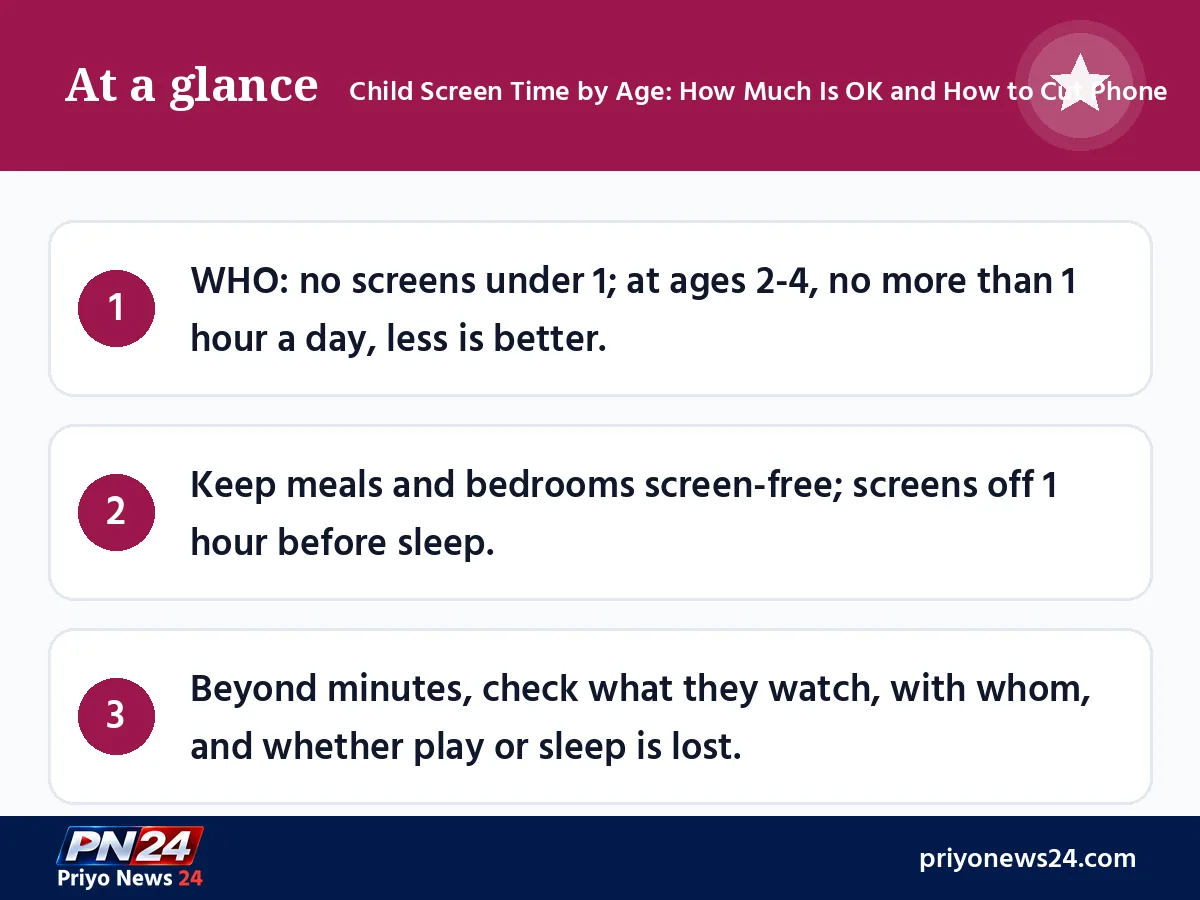
- WHO: no screens under 1; at ages 2-4, no more than 1 hour a day, less is better.
- Keep meals and bedrooms screen-free; screens off 1 hour before sleep.
- Beyond minutes, check what they watch, with whom, and whether play or sleep is lost.
Handing a child the phone to stop the crying, get them to eat or buy a few minutes of quiet is now a familiar scene in almost every home in Bangladesh. But how much child screen time is safe, and when does it turn into a habit that is hard to break? This guide brings together advice from the World Health Organization (WHO) and the American Academy of Pediatrics (AAP): age-by-age limits, the risks, and practical rules you can start at home. The information reflects guidance published up to November 2026.
How much screen time by age
In 2019, the WHO issued its first guidelines on physical activity, sedentary behaviour and sleep for children under 5. They include clear limits on screen time, and the AAP has given broadly similar advice for young children.
| Age | Screen time (WHO/AAP advice) | What they need more of |
|---|---|---|
| Under 1 year | None | Floor play, tummy time, being read to |
| 1 year | No sedentary screen time | Walking, toys, talking with adults |
| 18-24 months (AAP) | If any, high-quality content watched with an adult | Talking about pictures, songs and rhymes |
| 2 years | No more than 1 hour a day, less is better | Running around, books, colouring |
| 3-4 years | No more than 1 hour a day, less is better | At least 180 minutes of varied play a day |
| 5 years and older | Rules and balance matter more than a fixed number | Sleep, study, play and family time first |
The AAP treats video calls with family as an exception even for young children, because the child is interacting with real people.
Not just minutes: what they watch matters too
Several health and parenting publications report that the AAP's 2026 guidance puts more weight on content quality, a family media plan and the responsibility of apps and platforms for their design, rather than on counting minutes alone. So while limits matter for young children, ask these questions for older ones:
- What is the child watching? Is it age-appropriate, educational and slow-paced?
- Are they watching alone, or is an adult nearby talking with them?
- Is screen use pushing out sleep, play, study or family time?
- Are autoplay and endless short videos making them lose track of time?
How screens affect sleep and play
The core message of the WHO guidelines is to swap screen time for play and sleep. Recommended sleep for young children (including naps, per 24 hours):
| Age | Sleep (WHO) |
|---|---|
| 0-3 months | 14-17 hours |
| 4-11 months | 12-16 hours |
| 1-2 years | 11-14 hours |
| 3-4 years | 10-13 hours |
The WHO also says children under 5 should not be restrained for more than 1 hour at a time in a pram, high chair or strapped to someone's back. Screen light and exciting videos before bed can delay sleep, which is why the AAP advises switching screens off at least 1 hour before bedtime.
Risks of too much screen time and signs of overuse
Research has linked heavy screen time with less sleep, physical inactivity and weight gain, delays in speech and language in young children, and attention problems. Watching close up for long stretches also causes dry, tired eyes.
Warning signs to watch for:
- Intense anger, screaming or long crying when the phone is taken away
- Refusing to eat or sleep without the phone
- Losing interest in other toys or outdoor play
- Speech delay for their age, or responding less when called
- In older children, trouble focusing on study and using the phone secretly
If you see clear speech delay, little eye contact or a big change in behaviour, consult a paediatrician without delay.
10 house rules to reduce phone dependence
- Make a family media plan: write down who uses screens, when, for how long and where, and stick it on the fridge or wall. The AAP recommends this kind of family plan.
- Set screen-free zones: no phones or TV at the dining table or in bedrooms.
- All screens off 1 hour before bed: read or tell a story instead.
- Cut back step by step: reducing by 10-15 minutes a week makes it easier for children to adjust.
- Use a timer: give a 5-minute warning so it doesn't feel like the phone is snatched away.
- Keep alternatives within reach: blocks, crayons, picture books, a ball. Without alternatives, children drift back to the screen.
- Watch together: sit with them and talk about what is happening; the screen then becomes a way to learn.
- Turn off autoplay and short videos: set up a child profile and parental controls.
- No phone for feeding or calming: it is hard at first, but habits change within a few weeks.
- Lead by example: children copy adults. Put your own phone away when you are with your child.
Real problems in Bangladeshi homes, and fixes
- Grandparents or a helper hand over the phone: explain the rules to everyone in the family and give them play alternatives.
- No play space in the flat: take children to a roof, park or field for 30-60 minutes in the afternoon; at home, play ball, skipping or hide-and-seek.
- Online classes or homework: count study screens and entertainment screens separately, and take a break after study.
How to choose good content
If you do allow screens, you should decide what is watched, not an algorithm. A simple checklist:
- Slow pace: fast scene changes, loud sounds and flashing lights over-stimulate young children. Choose calm, gentle stories.
- Ad-free: ads in children's videos teach them to demand toys and snacks. Choose ad-free educational content where possible.
- Preview first: watch a few minutes yourself before giving a new channel or app.
- Language and values: rhymes, stories and nature content in Bangla help children learn the language.
- Content with an end: it is easy to stop after one episode or story, but hard to stop endless short videos.
A sample day for a 3-4-year-old
The WHO says children aged 3-4 need at least 180 minutes of varied physical play a day, at least 60 minutes of it energetic (running, jumping). Babies under 1 should get at least 30 minutes of tummy time a day. Here is one way to plan a day that still allows some screen time:
| Time | Activity |
|---|---|
| Morning | Breakfast (no screens), play on the balcony or in the yard |
| Late morning | Picture books, colouring, building with blocks |
| Midday | Lunch, then a nap |
| Afternoon | Running around in a field, park or on the roof |
| Evening | 20-30 minutes of a chosen cartoon, watched with an adult |
| Night | Dinner, a story, sleep with screens off |
Conclusion
Avoiding screens completely is not realistic today, and not all screen time is bad. What matters is following age-appropriate limits, choosing good content and putting sleep, play and family time first. Start today with one small rule, such as no phones at the dining table. If you are worried about your child's development, consult a doctor.
FAQ
How much screen time a day is right for a child?
The World Health Organization's 2019 guidelines say no screen time for babies under 1. At age 2 and at ages 3-4, sedentary screen time should be no more than 1 hour a day, and less is better. For older children, whether sleep, study, play and family time stay intact matters more than a fixed number of minutes.
Does a video call with grandparents count as screen time?
The American Academy of Pediatrics (AAP) advises avoiding screens for very young children but treats video chatting with family as an exception, because the child interacts with real people who respond. It helps most when an adult sits alongside and joins the conversation.
Is it harmful to show cartoons while feeding?
It is a very common habit, but it stops children learning taste, portion and the feeling of fullness, and they miss out on family conversation. The AAP recommends screen-free mealtimes. Cut the cartoons gradually and replace them with stories or talk about the food.
What are the signs of phone addiction in a child?
Intense anger or crying when the phone is taken away, no interest in other play, less sleep or eating, trouble focusing on studies, refusing to play outside and using the phone secretly are warning signs. If this lasts or you notice speech delay, consult a paediatrician.
Should I take the phone away completely and suddenly?
A sudden total ban often triggers strong reactions. It works better to cut time step by step, explain the rules in advance, use a timer and offer appealing alternatives such as toys, books and outdoor play.
Sources
- WHO — Guidelines on physical activity, sedentary behaviour and sleep for children under 5 years of age (2019)
- Health Policy Watch — WHO recommends young children play more, watch screens less, get plenty of sleep
- American Optometric Association — New WHO guidance: very limited daily screen time for children under 5
- AAP News — Policy addresses how to help parents manage young children's media use
- CHOC Children's — Updated AAP recommendations for screen time
- Contemporary Pediatrics — AAP calls for system-level changes to improve children's digital media environments
- The Conversation — Screen time guidelines for kids and adolescents have shifted
Comments
No comments yet — be the first to comment.