

Digital Marketing Career Guide: Skills, Income Paths and Future

At a glance
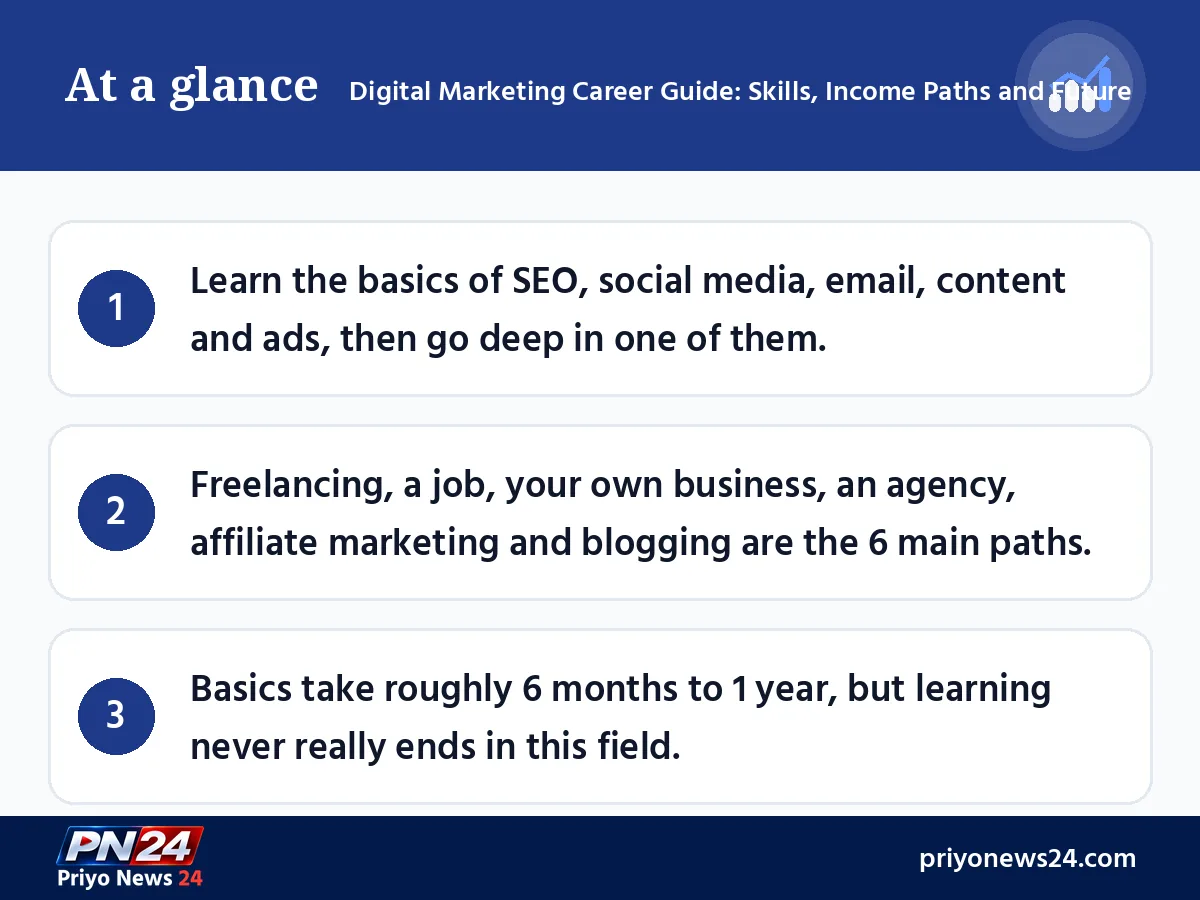
- Learn the basics of SEO, social media, email, content and ads, then go deep in one of them.
- Freelancing, a job, your own business, an agency, affiliate marketing and blogging are the 6 main paths.
- Basics take roughly 6 months to 1 year, but learning never really ends in this field.
A digital marketing career attracts many young people today, and the reason is simple: almost every business now looks for customers online, and people who do that well are in demand. But after saying "I want to learn digital marketing", most people get stuck on a few questions. What exactly should I learn? How will I earn once I have learned it? How long will it take, and what does the future look like?
This guide answers those questions step by step, drawing on Sultan Muhammad Rashed's long experience in online marketing and adding certification details updated as of November 2026. Read it through and apply it, and your career path will become much clearer.
The future of a digital marketing career
We live in an age of technology. Shopping, reading the news, learning and entertainment are all moving online, and so has a large share of marketing. From a small Facebook page to a large company, everyone needs people who can get products and services in front of the right audience online.
So if you enjoy this work and build your skills patiently, the future of a digital marketing career is bright. Competition is growing too, though. People who can deliver business results are worth far more than people who only know how to operate tools. AI tools now make many routine tasks easier, which makes strategy, analysis and creativity even more valuable.
Skills you need for a digital marketing career
Digital marketing is a large field with many branches inside it. The main ones are:
| Branch | What it does | Good fit for |
|---|---|---|
| Search engine optimisation (SEO) | Getting websites to rank higher on Google | People who like writing and analysis |
| Search engine marketing (SEM) | Running paid ads on Google | People who like numbers and budgets |
| Social media marketing | Promotion on Facebook, Instagram, LinkedIn, YouTube | Creative people who communicate well |
| Email marketing | Growing sales with regular emails to customers | Patient people who write well |
| Content marketing | Attracting people with blogs, video and graphics | Writers, designers, video makers |
| Affiliate and CPA marketing | Earning commission by promoting others' products or offers | People with their own audience or website |
| Influencer marketing | Promoting products through well-known faces | People who work with brands and communities |
| Marketing strategy and analytics | Planning the whole effort and measuring results | Experienced marketers |
Social media marketing itself splits into separate skills: Facebook, Instagram, LinkedIn, Pinterest, YouTube and X (Twitter) marketing. For the types, pros and cons of digital marketing in detail, read What Is Digital Marketing? Types, Pros, Cons and Online vs Offline.
The advice: know the basics of every branch, but go deep in one or two. Otherwise you may get stuck at some point in your career.
6 ways to earn with your skills
Suppose you have learned the skills above. How will you actually earn? Pick the path below that suits you best.
1. Outsourcing or freelancing
You can work from home for clients in Bangladesh or abroad. You need a good internet connection and a laptop or computer. Marketplaces such as Fiverr, Upwork, Freelancer.com and PeoplePerHour all have dedicated digital marketing categories. Set up your profile carefully, start with small jobs and build up reviews. Many freelancers in Bangladesh earn well this way.
2. Your own online business
With digital marketing skills you can sell your own products. An online business has no shop rent, so you can start with little capital. Thousands of people in Bangladesh run businesses with just a Facebook page. As you grow, a ready platform such as eCommerce Autopilot, which brings a website, orders, payments, courier and AI help together, makes it easier to manage everything in one place.
3. Affiliate marketing
Affiliate marketing means selling on commission. Say a company offers you a share of the price for every product you help sell. You review the product honestly on your website, YouTube or social media, a sale happens and the company pays you a commission. Amazon, eBay, Walmart, AliExpress, CJ Affiliate and many others run affiliate programmes; check each one's official page for terms and country rules before joining.
4. Blogging and Google AdSense
If you build a website with useful writing on a specific topic, visitors arrive from Google Search. Google AdSense shows ads to those visitors, and that earns you money. You can also earn from relevant affiliate products or sponsored content. Blogging income takes time to arrive, but good content can keep earning for years.
5. A job at a company
Nearly every company's marketing department now needs people who know digital marketing. Job sites regularly list roles such as digital marketing executive, SEO specialist, social media manager and performance marketer. Many roles are remote, so working for companies abroad is also possible.
6. Your own marketing agency
After a few years of experience and some happy clients, you can start your own digital marketing or social media agency. Your biggest asset there is client satisfaction; good feedback is what takes an agency to the next level.
Extra income: training and consulting
With a few years of hands-on experience, you can also earn by training, mentoring or consulting. To reach this stage you need real work experience across the branches. For business or marketing advice, you can get in touch through Sultan Muhammad Rashed's website.
How long does it take to learn digital marketing?
In a word, learning never ends. Digital marketing is an industry that keeps changing; platform rules, algorithms and tools are updated all the time. Thinking you are done after one course is a mistake.
That said, getting the basics of the main branches and becoming good enough in one to start working usually takes 6 months to 1 year of regular practice. A simple plan could look like this:
| Time | What to learn |
|---|---|
| Months 1-2 | Marketing fundamentals, customer behaviour, online vs offline marketing, the marketing mix |
| Months 3-4 | Basics of SEO, social media, content and email marketing |
| Months 5-6 | Paid ads (Google and Meta) and analytics |
| Months 7-12 | Pick one branch, practise deeply on your own or small client projects, build a portfolio |
There is no fixed course module; it differs by trainer. Good courses usually start with marketing fundamentals, the components of digital marketing, digital life in Bangladesh, customer behaviour, common mistakes and why campaigns fail, building an online presence and the 7Ps of marketing.
Certifications that help (as of November 2026)
Remember: your real results, not certificates, are the true proof of your skill. Still, some certifications are well known to employers and clients:
- Google Skillshop: the foundational Google Ads and Google Analytics certifications are free. Google has also introduced professional certifications (Search, Display, Video) with remotely proctored exams, and says these will require a fee in the future.
- HubSpot Academy: many courses and certifications, including inbound, content and email marketing, are free. The inbound marketing course, for example, is about 5 hours long.
- Meta: Blueprint learning modules are free, but official certification exams charge a fee that can vary by country, so check before you register.
What income looks like and what it depends on
It is impossible to say exactly how much you will earn in digital marketing. One person writes content, another runs large ad budgets, and their incomes will not be the same. Income depends on:
- Your branch and your skill level
- How much experience and how strong a portfolio you have
- Whether clients are local or international, small or large
- Whether you work alone or as a team or agency
As in any profession, income is low at first and rises with experience. There is a floor but no ceiling, and those who keep improving with patience move ahead. Many people are leaving other careers for this one because it offers both opportunity and freedom.
A warning: stay away from apps and offers that promise money for watching videos or clicking ads. That is not digital marketing, and most of it is a scam.
Final thoughts
You do not need a big degree or big capital to start a digital marketing career. You need curiosity, patience and regular practice. Learn the basics of every branch, go deep in one, build a portfolio with small projects, then choose the path that fits you: freelancing, a job or your own business. Pick one branch today and take the first step.
FAQ
How long does it take to learn digital marketing?
With regular practice, getting the basics of the main branches plus job-ready skill in one of them usually takes 6 months to 1 year. Because platforms and algorithms keep changing, learning continues throughout your career.
How much can you earn from digital marketing per month?
There is no fixed figure. Income depends on your branch, skill level, experience, where your clients are and how you work (job, freelance or your own business). It starts low and grows with experience and a stronger portfolio.
Can I learn and do digital marketing with just a mobile phone?
You can start learning, managing social media or creating simple content on a phone. For SEO audits, ad campaigns and reporting, a computer makes the work much easier.
Which digital marketing certification is best?
Real results matter more than certificates. Still, Google Skillshop's free Google Ads and Analytics certifications, HubSpot Academy's free courses and Meta's certification exams are well known to employers and clients.
Which branch should a beginner start with?
Start with the work you enjoy. If you like writing, try content and SEO; if you like design or video, social media; if you like numbers and analysis, paid ads and analytics.
Comments
No comments yet — be the first to comment.