

Is Your Fast Valid Without Taraweeh? Ruling, Rak'ahs and Virtues

At a glance
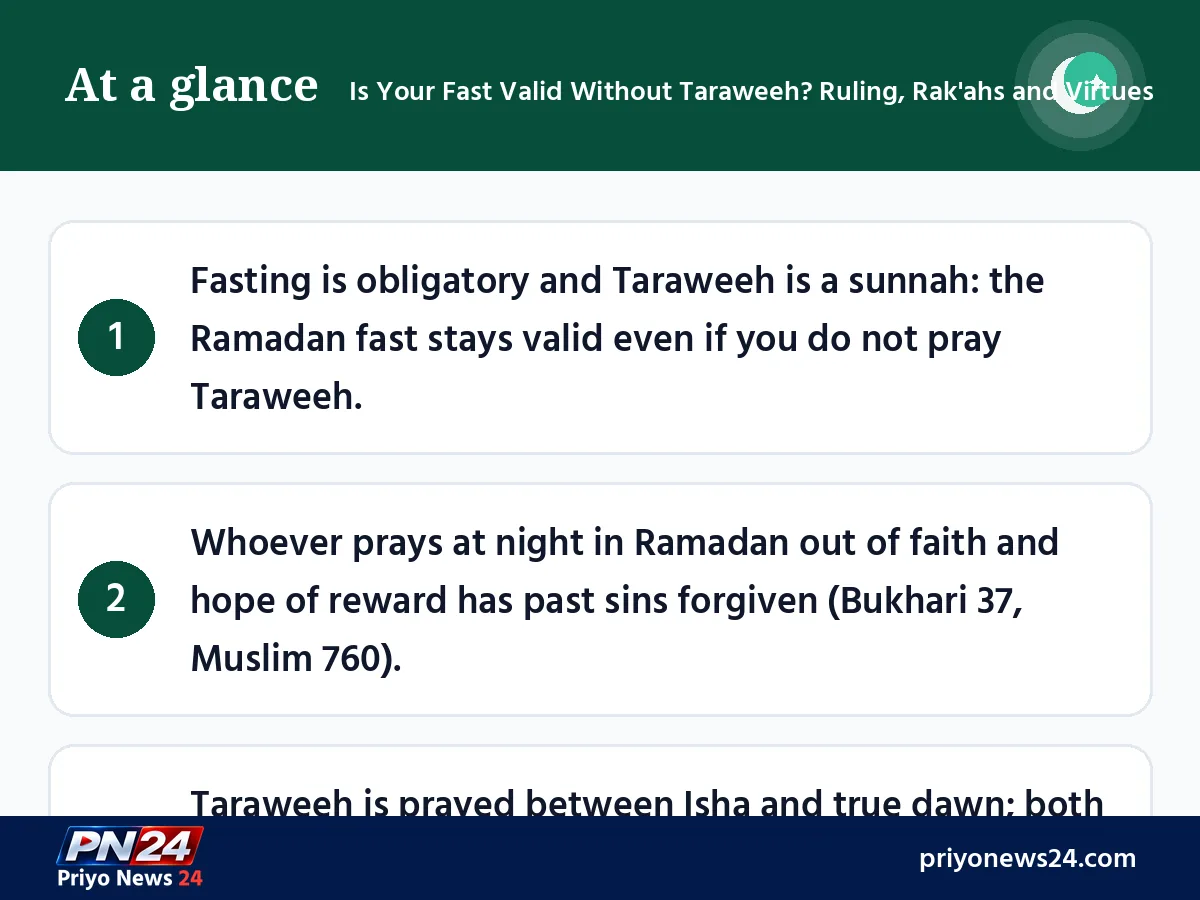
- Fasting is obligatory and Taraweeh is a sunnah: the Ramadan fast stays valid even if you do not pray Taraweeh.
- Whoever prays at night in Ramadan out of faith and hope of reward has past sins forgiven (Bukhari 37, Muslim 760).
- Taraweeh is prayed between Isha and true dawn; both 8 and 20 rak'ahs are recognised views, with Witr prayed after it.
Every Ramadan the same question comes up: is your fast valid without Taraweeh? Work pressure, illness, travel or getting home late means many people miss Taraweeh on some nights, and then they worry that the day's fast was wasted. This guide answers the question in plain language, based on the Quran, authentic hadith and scholars' explanations, and also covers the ruling on Taraweeh, the number of rak'ahs, its timing, its history and its virtues.
One point is worth keeping in mind from the start: asking questions to learn is good, but turning rak'ah counts or rulings into a source of argument and division is never appropriate. This discussion is only meant to inform.
Is your fast valid without Taraweeh? The short answer
Yes, your fast is valid. The validity of the fast does not depend on Taraweeh. The Ramadan fast is fard (obligatory), while Taraweeh is sunnah muakkadah (an emphasised sunnah). If you fast properly during the day but do not pray Taraweeh at night, your obligatory fast is still fulfilled.
That does not mean Taraweeh can be taken lightly. Skipping it does not break your fast, but you lose the great reward and status of worship on Ramadan nights. Put simply:
- Not fasting without a valid excuse is a serious sin, because you abandon an obligation.
- Not praying Taraweeh leaves your fast intact, but you miss a major blessing.
Fasting and Taraweeh are two separate acts of worship
A fast is valid when you make the intention and abstain from food, drink and marital relations from true dawn (subh sadiq) to sunset. You can read how to make the intention in our guide Niyyah for Fasting: Meaning, Arabic Text, Timing and Rules. Taraweeh is not one of these conditions. The table below shows the difference at a glance:
| Aspect | Ramadan fast | Taraweeh prayer |
|---|---|---|
| Ruling | Fard (Surah al-Baqarah, verse 183) | Sunnah muakkadah |
| Time | True dawn to sunset | After Isha until true dawn |
| If missed | Serious sin without an excuse; must be made up | Fast stays valid; sunnah reward is lost |
| Who | Adult, healthy, resident Muslims | Sunnah for everyone, according to ability |
| How | Intention and abstaining all day | Prayed two rak'ahs at a time, then Witr |
So leaving one act of worship does not cancel the other. They are independent, although in Ramadan doing both is best.
Is Taraweeh sunnah or nafl? Fard or wajib?
This is one of the most frequently asked questions. The well-known scholarly position is that Taraweeh is sunnah muakkadah, a sunnah that carries special emphasis. It is not fard, and it is not wajib.
- Why it is not fard: The Prophet (peace be upon him) led it in congregation in the mosque for a few nights and then stopped coming out, explaining that he feared it might become obligatory for his community (Sahih al-Bukhari 2012). It was therefore left optional.
- Why it is not an ordinary nafl: The Prophet prayed it himself, encouraged it, and the Companions kept it up consistently, which makes it an important sunnah.
Scholars explain that the four rak'ahs of sunnah before Isha are sunnah ghair muakkadah (less emphasised), while Taraweeh is sunnah muakkadah. In terms of emphasis, Taraweeh carries more weight.
The virtue of Taraweeh: what the hadith says
The best-known hadith on night prayer in Ramadan is narrated by Abu Hurairah (RA). Its meaning: whoever stands in prayer on the nights of Ramadan out of faith and in hope of reward will have his past sins forgiven (Sahih al-Bukhari 37 and 2008; Sahih Muslim 760).
Another narration says that whoever prays with the imam until he finishes is credited with praying the whole night (Abu Dawud 1227, Tirmidhi 806). That is why scholars advise staying with the imam until the end when you pray Taraweeh in the mosque.
The history of Taraweeh: from the Prophet to Umar (RA)
Knowing the history of congregational Taraweeh clears up a lot of confusion. The narrations in the Book of Tarawih in Sahih al-Bukhari give this sequence:
- The Prophet's time: He prayed in the mosque on several nights in Ramadan and the crowd grew each night. He then stopped coming out, fearing it would become obligatory (Bukhari 2012).
- The caliphate of Abu Bakr (RA) and the early years of Umar (RA): People prayed individually or in small separate groups (Bukhari 2009).
- Umar's initiative: Seeing people praying in scattered groups in the mosque, Umar (RA) gathered them behind one reciter, Ubayy ibn Ka'b (RA), and described the arrangement as a good initiative (Bukhari 2010).
Since then, praying Taraweeh in congregation behind one imam in the mosque has continued throughout Ramadan.
How many rak'ahs is Taraweeh: 8 or 20?
There are two well-known scholarly views on the number of rak'ahs, and both have evidence:
| View | Evidence and explanation | Where it is common |
|---|---|---|
| 8 rak'ahs + 3 Witr | Aisha (RA) said the Prophet never prayed more than 11 rak'ahs at night, in Ramadan or otherwise (Bukhari 2013) | Many scholars, including IslamQA |
| 20 rak'ahs + 3 Witr | Scholars note that 20 rak'ahs in congregation was practised among the Companions in Umar's time | Mosques in Bangladesh and other Hanafi regions |
An analysis published in Prothom Alo notes that someone who can stand for long may pray fewer rak'ahs with long recitation, as the Prophet did, while someone who cannot may pray 20 rak'ahs with shorter recitation. The real aim is to pray with focus and humility, not in a rush. Following your local mosque and scholars is the most peaceful path, and respecting people who follow the other view matters.
Time and method of Taraweeh
- Time: After the Isha fard and sunnah prayers until true dawn. The Prophet did not fix a specific time; Umar (RA) said the last part of the night was even better (Bukhari 2010).
- Method: It is prayed two rak'ahs at a time, each pair ending with salam.
- Rest: It is customary to sit and rest briefly after every four rak'ahs, using the pause for dhikr, salawat or dua. No specific dua is required.
- Witr: Witr is the last prayer of the night, so it is prayed after Taraweeh.
- Khatm Taraweeh: Many mosques in Bangladesh complete the whole Quran once in Taraweeh during Ramadan; the Islamic Foundation suggests reciting one and a half juz a night for the first six nights and one juz a night after that, so the Quran is completed before Laylatul Qadr.
What to do if you cannot pray Taraweeh
Illness, travel, night shifts or other reasons can mean missing Taraweeh on some nights. There is no reason to despair:
- Don't worry about your fast. If you fasted properly, it counts.
- Pray as much as you can. IslamQA advises that if you cannot pray the full Taraweeh, pray what you can, even two rak'ahs, and then Witr.
- Pray at home. If you cannot reach the mosque, pray alone or with your family at home; it still earns reward.
- Be regular on the remaining nights. Focus on the nights ahead rather than the ones you missed.
- Don't make skipping a habit. Scholars dislike abandoning an emphasised sunnah regularly without a reason.
Final word
Is your fast valid without Taraweeh? The answer is clear: yes, because fasting and Taraweeh are separate acts of worship. But Ramadan comes only once a year, and its nights are a special opportunity for forgiveness. Try to pray Taraweeh as far as you are able, and focus on praying with attention rather than arguing over rak'ah counts. If you have doubts about a specific ruling, ask a trusted scholar in your area.
FAQ
Is my fast valid if I don't pray Taraweeh?
Yes. Fasting and Taraweeh are separate acts of worship. A fast is valid when you make the intention and abstain from food, drink and marital relations from true dawn to sunset. Skipping Taraweeh does not break the fast, but you miss its considerable reward.
Is Taraweeh sunnah or nafl?
Most scholars describe Taraweeh as sunnah muakkadah, an emphasised sunnah. It is neither fard (obligatory) nor wajib. The Prophet (peace be upon him) prayed it in Ramadan and encouraged it.
How many rak'ahs is Taraweeh?
There are two well-known views. Aisha (RA) reported that the Prophet never prayed more than 11 rak'ahs at night, in Ramadan or otherwise (Bukhari 2013), which gives 8 rak'ahs plus 3 Witr. Since the time of Umar (RA), 20 rak'ahs in congregation has also been practised, and this is the norm in Bangladesh and other Hanafi regions. Both are accepted scholarly positions.
When is the time for Taraweeh?
Any time after the Isha fard and sunnah prayers until true dawn (subh sadiq). It is usually prayed in congregation right after Isha, and Witr is prayed after Taraweeh.
Is it a sin to miss Taraweeh on some nights?
Taraweeh is not obligatory, so missing it for a reason such as illness or travel is not like missing an obligatory prayer. Scholars do, however, dislike habitually abandoning an emphasised sunnah without a reason. Try to pray it regularly on the remaining nights.
Can I pray Taraweeh alone at home?
Yes. The Prophet led it in the mosque for a few nights, then stopped coming out for fear it would become obligatory (Bukhari 2012). Praying at home alone or with family still earns reward, while congregation in the mosque has its own virtue.
Comments
No comments yet — be the first to comment.