

Erasmus Mundus Scholarship: A Step-by-Step Guide to Fully Funded Master's in Europe for Bangladeshi Students

At a glance
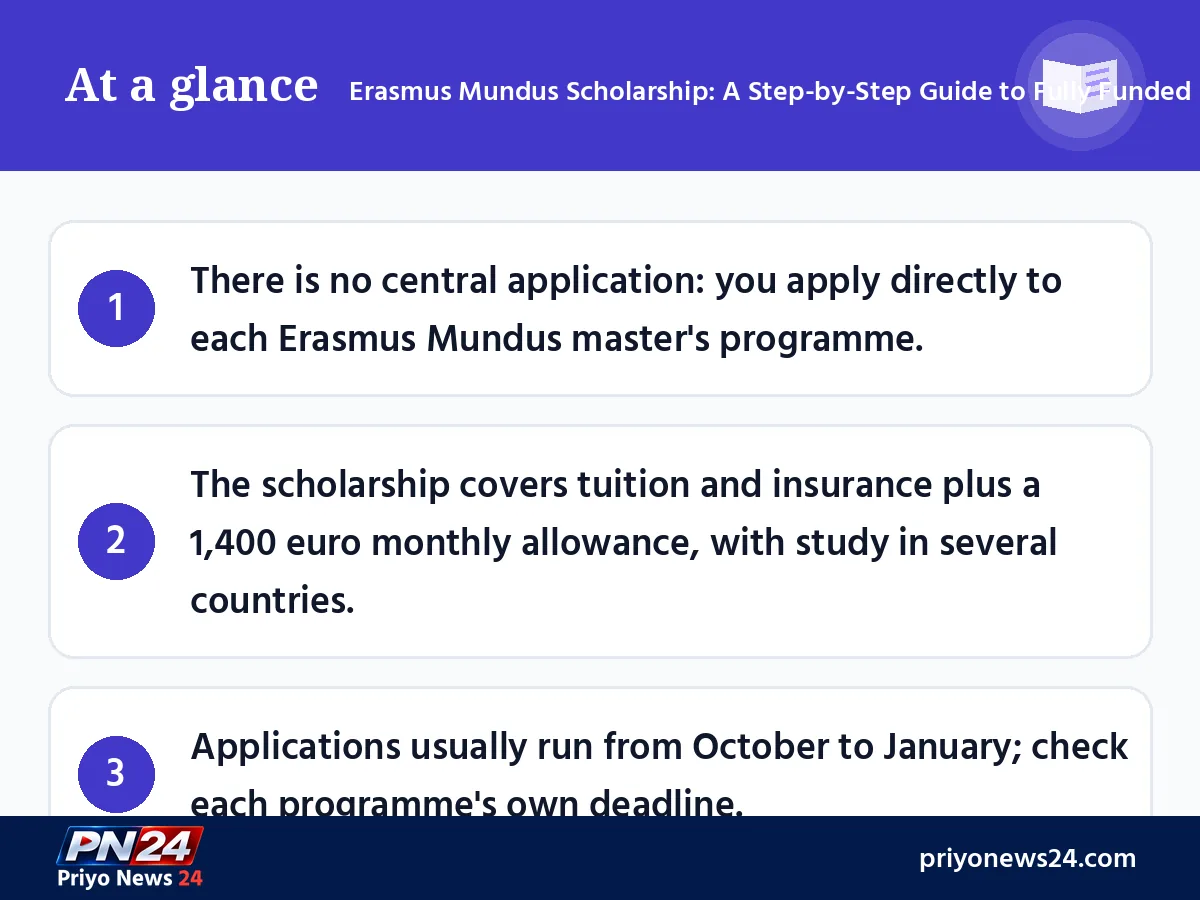
- There is no central application: you apply directly to each Erasmus Mundus master's programme.
- The scholarship covers tuition and insurance plus a 1,400 euro monthly allowance, with study in several countries.
- Applications usually run from October to January; check each programme's own deadline.
Of all the ways to do a master's degree in Europe without paying for it, the best known and most competitive is the Erasmus Mundus scholarship. Under the European Union's Erasmus+ programme, these scholarships are awarded for Erasmus Mundus Joint Master's (EMJM) programmes, in which a student usually studies at universities in two or more European countries and receives a joint or multiple degree. Every year many students from Bangladesh win one. But because the application process is different from other scholarships, many people are confused from the start. Based on information available as of November 2026, this guide shows step by step how to prepare.
What the Erasmus Mundus scholarship actually is
Erasmus Mundus is not a scholarship from a single university. Several European universities (sometimes with partners outside Europe) form a "consortium" and run a joint master's programme in a specific field. The European Commission funds the programme, and the programme awards scholarships to its best applicants.
Keep a few features in mind:
- No central application. Each programme has its own website, its own application form and its own deadline.
- Study in several countries. Usually each semester or year is spent at a university in a different country.
- Duration. Programmes usually last 1 to 2 years (60, 90 or 120 ECTS credits).
- Wide range of subjects. There are programmes in almost every field, including engineering, data science, environment, public health, agriculture, economics and the humanities. Several scholarship guides report that the catalogue for the 2027 intake lists more than 200 programmes.
What the scholarship covers
| Benefit | Details |
|---|---|
| Tuition and participation costs | Full programme tuition and health insurance are included |
| Monthly allowance | A living allowance of 1,400 euros a month for the whole study period |
| Several countries | Study, internship or research in at least 2 countries |
| Degree | A joint degree, or several degrees from the partner universities |
How travel and accommodation support is handled is set out in each programme's rules. Before applying, read the programme's "Scholarship" or "Fees and funding" page in full. Remember that the monthly allowance covers a modest lifestyle; rent is high in Europe's big cities, so you will need to budget.
Who can apply
The Erasmus Mundus scholarship is open to students from any country in the world, so Bangladeshis can apply. The usual conditions are:
- A bachelor's degree: a four-year bachelor's or equivalent. In many programmes final-year students can also apply, on condition that they finish the degree before enrolment.
- A related subject: previous study in a field connected to the programme.
- English proficiency: an IELTS, TOEFL or equivalent score. The programme sets the required score.
- No previous scholarship: someone who has already received an Erasmus Mundus master's scholarship generally cannot receive another.
- Application limit: you can apply for a scholarship to a maximum of 3 different Erasmus Mundus programmes in one year.
Work experience is not compulsory for most programmes, which sets this scholarship apart from schemes such as Chevening.
Step-by-step application process
Step 1: Choose programmes from the catalogue
The European Commission's Education, Audiovisual and Culture Executive Agency (EACEA) publishes the Erasmus Mundus catalogue. Search it by subject. Look at each programme's curriculum, which countries you would study in and who it admits, then pick the 3 that best match your bachelor's subject and career goals.
Step 2: Build a list of deadlines
Most programmes accept applications between October and January, and some stay open until February or March. But every programme's dates are different. Keep a spreadsheet with the programme name, deadline, required IELTS score and list of documents.
Step 3: Prepare your documents
What is usually needed:
- A copy of your passport
- Bachelor's certificate and transcript (in English, attested where required)
- IELTS or TOEFL score
- A CV, often in the Europass format that many programmes ask for
- A motivation letter or statement of purpose
- 2 reference letters, usually from teachers or a supervisor at work
- Proof of residence (some programmes ask for it)
Step 4: Write the motivation letter
This is the most important part of the application. Write a separate letter for each programme. Explain with specific examples why this particular programme, which of its courses or universities fit your goals, how your previous study and projects prepared you, and what you want to contribute in Bangladesh or in your field after graduating. Selectors can easily tell when the same letter has been sent to every programme.
Step 5: Submit online and wait for results
Submit the application on the programme portal and keep the confirmation email. Some programmes hold a short online interview. Results usually arrive between March and May. Applicants are told whether they are on the "main list", the "reserve list" or offered a "self-funded" place. If you are on the reserve list, you may still get a scholarship later if others turn their offers down.
Step 6: Prepare for the visa
Once the scholarship is confirmed, you apply for the visa of the first country where you will study. Many European countries have no embassy in Bangladesh, so in some cases you may need to go to an embassy in Delhi or another city. The programme usually provides the letters needed for the visa, so contact them early.
A sample preparation timeline
For those who want to start studying in September next year, here is a realistic plan. The months are approximate; adjust them to the deadlines of the programmes you choose.
| When | What to do |
|---|---|
| June-August | Choose programmes from the catalogue, start IELTS preparation |
| September-October | Take IELTS, collect certificates and transcripts, contact referees |
| October-December | Write a motivation letter and Europass CV for each programme |
| December-January | Submit applications at least a week before each deadline |
| March-May | Results, interviews, accepting an offer |
| May-August | Visa application, finding accommodation, preparing to travel |
Following this plan helps you avoid a last-minute rush and give each application enough time.
Tips to improve your chances
- Good grades matter, but they are not everything. Relevant research, a thesis, publications, internships or volunteer work strengthen your profile.
- Get references from the right people. A letter from someone who knows you closely and can give specific examples carries more weight.
- Consider new programmes. New programmes are added every year, and competition for them is sometimes lower.
- Do not wait for the last week. Portals are busy near deadlines, and attesting documents takes time.
- Beware of fraud. Only the programme consortium selects students. Avoid anyone who offers to guarantee a scholarship for money.
Common mistakes
| Mistake | Why it is a problem |
|---|---|
| Applying to a programme unrelated to your degree | Risk of rejection at the first eligibility check |
| The same motivation letter for every programme | It makes your interest and preparation look weak |
| Taking the English test late | Risk of the score not arriving before the deadline |
| Ignoring the required format | The application may be rejected as incomplete |
Final word
The Erasmus Mundus scholarship is competitive but not impossible. With the right programme choice, an English score on time, a separate motivation letter for each programme and strong references, students from Bangladesh can do a master's degree across several European countries at no cost. Applications for the 2027 intake are now open in many programmes, so start building your list from the catalogue today, and verify every detail on the programme's official website.
FAQ
How much does the Erasmus Mundus scholarship pay?
Under European Commission rules, the scholarship covers the programme's participation costs (tuition and insurance) and pays a living allowance of 1,400 euros a month for the whole study period. Details can differ slightly by programme, so check the programme website.
Do I need IELTS for Erasmus Mundus?
Most programmes ask for IELTS, TOEFL or an equivalent proof of English. Some accept a university certificate if your previous degree was taught in English. Each programme sets its own minimum score.
How many Erasmus Mundus programmes can I apply to?
You can apply for a scholarship to a maximum of 3 different Erasmus Mundus Joint Master's programmes in one year. So pick the 3 that match your subject and profile best.
Can I get Erasmus Mundus without work experience?
Yes. Many programmes do not require work experience, and recent graduates or final-year students can apply. Some programmes do give extra points for relevant experience.
Is there an application fee for Erasmus Mundus?
Most programmes charge no application fee, though a few may charge a small one under their own rules. Be careful of any agency that promises a scholarship for money; only the programme consortium selects students.
Comments
No comments yet — be the first to comment.