

How to Apply for Death Registration Online in Bangladesh: Documents, Fees and Certificate

At a glance
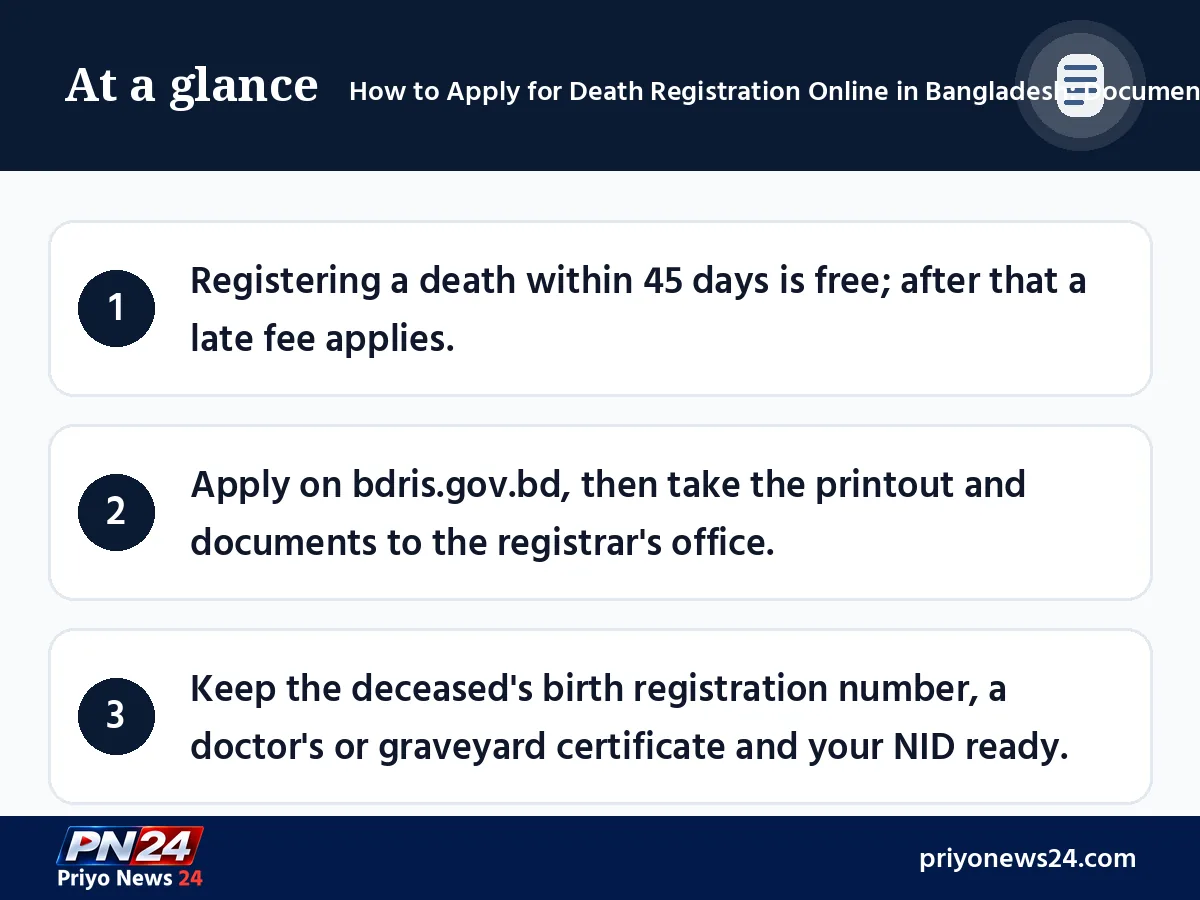
- Registering a death within 45 days is free; after that a late fee applies.
- Apply on bdris.gov.bd, then take the printout and documents to the registrar's office.
- Keep the deceased's birth registration number, a doctor's or graveyard certificate and your NID ready.
When someone in the family dies, a few official tasks have to be handled even in the middle of grief. The inheritance (warish) certificate, withdrawing money from bank accounts or savings certificates, pensions, insurance claims and land mutation almost always start with one document: the death certificate. To get it, the death must first be registered. The good news is that death registration online in Bangladesh is now fairly simple: you fill in the form from home and then visit the registrar's office once with the printout and a few documents.
This guide explains, step by step, who can apply, which documents you need, what it costs, where to submit and how to collect the certificate. The information has been checked against government websites and local government guidance as of November 2026. Portal menu names change from time to time, so if a step does not match, ask your union parishad or municipality.
Why death registration matters and the deadline
Under the Births and Deaths Registration Act, 2004, registering every death in Bangladesh is mandatory, and it should be done within 45 days of the death. There is no fee within that period. If you are late, registration is still possible, but a late fee applies.
A death certificate is usually needed for:
- the inheritance (warish) certificate and dividing property
- transferring bank accounts, savings certificates, shares or mobile banking balances to heirs
- government or private pensions and family pensions
- life insurance claims
- land mutation (namjari)
- updating the deceased's national ID and other records
So it is wise to complete the registration once the first days of mourning have passed; it saves a lot of running around later.
What to keep ready before you apply
Guidance from local government offices shows that death registration usually needs the following:
| What you need | Why |
|---|---|
| The deceased's birth registration number (17 digits) and date of birth | The online form asks for these first |
| A copy of the deceased's national ID card (if any) | To match the identity |
| Proof of death: a hospital or doctor's death certificate, or a graveyard/cremation ground certificate | To confirm the date and place of death |
| The applicant's national ID or birth registration | To verify who is applying |
| An active mobile number | For updates and contact |
| Proof of permanent address if asked (holding tax receipt or a chairman/councillor certificate) | To decide which office registers the death |
The applicant is usually a close relative: the husband or wife, a child, a parent or a sibling. Some offices ask for extra papers, so it is worth phoning before you go.
How to apply for death registration online: step by step
Step 1 — Open the portal: In a phone or computer browser, open the government birth and death registration system at bdris.gov.bd and choose "Death Registration" or "Apply for death registration". Residents of Dhaka South City Corporation can use the corporation's own portal, bdris.dscc.gov.bd.
Step 2 — Choose the registration office: Select the country, division, district, upazila and union/municipality/city corporation according to the deceased's permanent address. You will submit your documents at the office you choose here.
Step 3 — Details of the deceased: Enter the birth registration number and date of birth; much of the information then fills in automatically. Add the date of death, place of death (home, hospital and so on) and cause of death. Be very careful with the date, because corrections later are a hassle.
Step 4 — Applicant's details: Enter your name, your relationship to the deceased, your NID or birth registration number and your mobile number.
Step 5 — Check and submit: Review everything once more and click "Submit". An application number appears on screen; write it down or take a screenshot.
Step 6 — Print and submit at the office: Print the application. Attach photocopies of the documents above and submit them at the registrar's office of the selected union parishad, municipality or city corporation. Pay any fee there if required.
Step 7 — Approval and certificate: After the registrar verifies the documents and approves, the death registration certificate is printed for you. Check the name, dates and number on it straight away.
Death at home or in hospital: different proof
If the death happened in a hospital or clinic, a death certificate signed by a doctor is usually issued there. Collect it before leaving the hospital, because getting it later needs a separate request and more time.
A death at home does not come with such a paper. In that case, many offices accept a burial or cremation certificate from the graveyard or cremation ground authority, or a certificate from the local union parishad member or ward councillor. Ask in advance which paper your office accepts so you can finish in one visit.
If an application is rejected, the office normally tells you why, such as mismatched information or a missing document. Fix the reason and apply again; resubmitting the same information does not help.
How much does death registration cost?
According to the Office of the Registrar General's fee list and local government notices:
- Registration within 45 days of death: free
- After 45 days: a fixed late fee applies (the government fee list sets 25 taka for this)
Fees can change by government decision. On the day you apply, check the fee list on orgbdr.gov.bd or the office notice board, and always ask for a receipt. If anyone demands more than the official fee, you can report it to the Upazila Nirbahi Officer or the municipality's chief executive.
If the death happened abroad
If a Bangladeshi dies abroad, the Bangladesh embassy or consulate in that country accepts the death registration application. Missions in Hong Kong, Paris, Ankara and elsewhere have a dedicated "Death Registration" page listing the documents, such as the local hospital or authority's death certificate, a passport copy and the applicant's papers. Doing it alongside the repatriation of the body makes inheritance work back home much easier.
Common mistakes to avoid
- Choosing the wrong office: picking an office outside the permanent address can stall the application.
- A wrong date of death: if it does not match the hospital or graveyard certificate, the application may be rejected.
- Name spelling mismatches: if the name differs between the birth registration and the NID, ask the office first.
- Losing the application number: it is hard to follow up without it; keep it safe.
- Relying on middlemen: you can do the whole process yourself; never share passwords or OTPs with strangers.
After you get the certificate
Make several attested photocopies of the death certificate, because banks, insurers and land offices each ask for their own copy. Then apply for the inheritance certificate at the union parishad or municipality. To verify the certificate, you can use the verification section of the government BDRIS system with the registration number and date.
Final word
An easy way to remember the process: apply within 45 days, keep the deceased's birth registration number at hand, and submit the printout with proof of death at the registrar's office. Get this right and the family's later legal and financial tasks move much more smoothly.
FAQ
Within how many days must a death be registered?
Under the Births and Deaths Registration Act, 2004, a death should be registered within 45 days. Registration within that period is free. You can still register later, but a late fee is charged.
Where do I apply for death registration online?
Use the 'Death Registration' section of the government birth and death registration system at bdris.gov.bd. Residents of the Dhaka South City Corporation area can also use the corporation's own portal, bdris.dscc.gov.bd. After submitting, take the printout to the registrar's office.
What if the deceased had no birth registration?
The online form usually asks for the deceased's birth registration number and date of birth. If there is no number, or you cannot find it, first contact the registrar at the union parishad, municipality or city corporation; they will tell you how to proceed in your case.
How long does it take to get the death certificate?
Once the registrar verifies the documents and approves the application, the certificate can be printed. Many offices finish within a few days, but there is no single deadline everywhere. If it is delayed, follow up at the office with your application number.
Where is a death abroad registered?
If a Bangladeshi citizen dies abroad, the Bangladesh embassy or consulate in that country accepts the death registration application. Each mission lists the required documents on its website.
Sources
- Office of the Registrar General — Birth and Death Registration Fees
- Dhaka South City Corporation — Death Registration Application (BDRIS)
- Raysree South Union, Chandpur — Online death registration rules
- National Portal — Death registration application form
- Embassy of Bangladesh, Ankara — Birth & Death Registration
- Bangladesh Consulate General, Hong Kong — Death Registration
Comments
No comments yet — be the first to comment.