

How to Choose the Best SEO Service or Company: 10 Questions, Packages and Red Flags

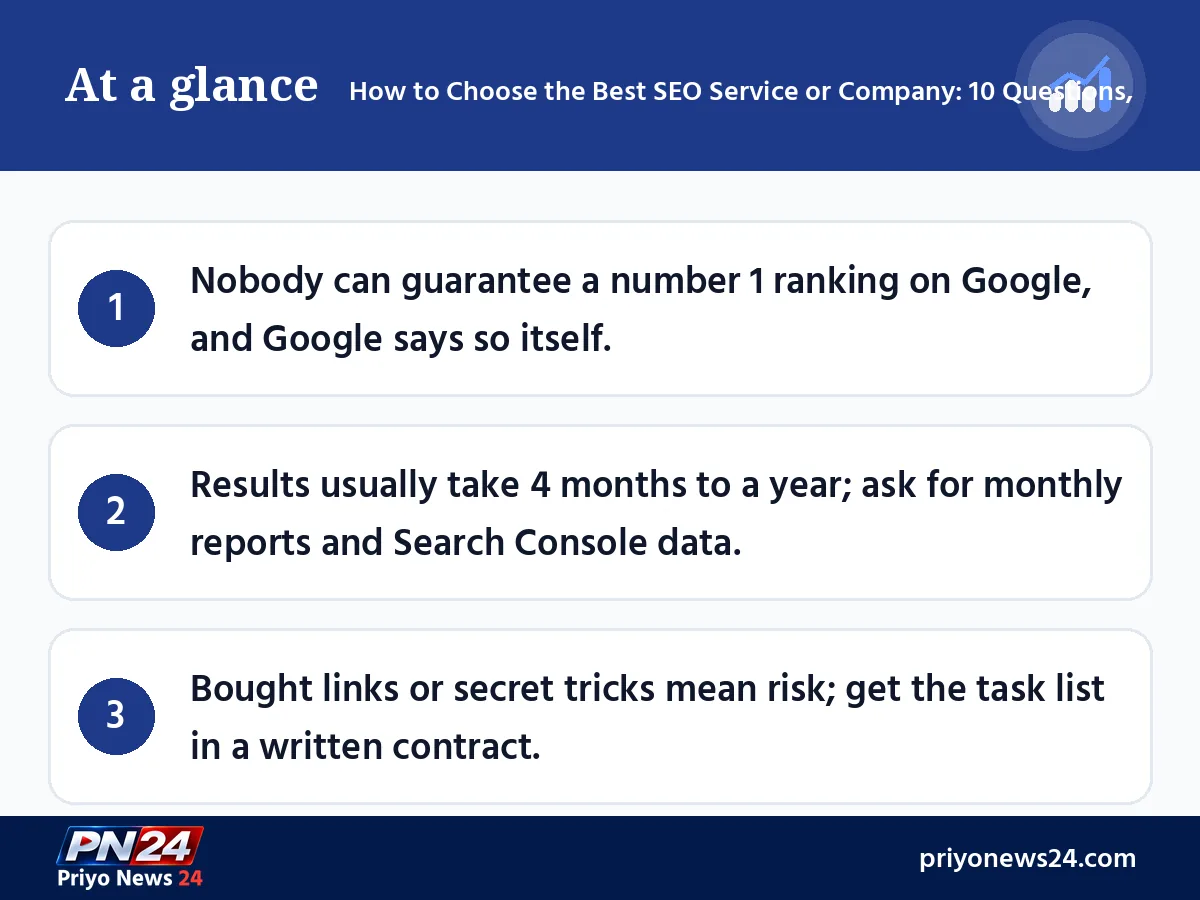
At a glance
- Nobody can guarantee a number 1 ranking on Google, and Google says so itself.
- Results usually take 4 months to a year; ask for monthly reports and Search Console data.
- Bought links or secret tricks mean risk; get the task list in a written contract.
Business owners often type "best seo company" or "best seo service" into Google. The results are full of agencies, freelancers and ads promising "page one in 30 days". But the best SEO is not the most expensive package or the one with the boldest promise. Good SEO makes your site genuinely useful to people and easy for search engines to understand, without breaking Google's rules.
This guide uses Google Search Central's own advice (as published up to November 2026) to show what to ask an SEO consultant or company, what a good SEO package contains and which warning signs should make you walk away. It is written with businesses in Bangladesh in mind, but the advice applies anywhere.
What "best SEO" really means
SEO (Search Engine Optimization) is the work of helping search engines understand your content and helping people find your site through search. Google's SEO Starter Guide puts the foundation on helpful, reliable content written for people, a clear site structure and pages that search engines can crawl.
So "good seo" or "top seo" work happens on several layers:
- Technical: can the site be crawled and indexed, does it work on mobile, does it load fast?
- On-page: titles, headings, image alt text, internal links and content that answers what people search for.
- Content and SEO copywriting: clear answers to readers' questions, written naturally rather than stuffed with keywords.
- Off-page and local: links earned naturally, brand recognition and, for local businesses, a Google Business Profile.
A good SEO company covers all four. It does not just sell "100 backlinks".
What Google itself says
Google Search Central's page "Do you need an SEO?" makes a few points that matter most when choosing:
- No one can guarantee a number 1 ranking on Google. Be suspicious of anyone who does.
- Nobody has a "special relationship" with Google or a "priority submit". Such claims are false.
- It takes time. In most cases it can take four months to a year to implement improvements and see a potential benefit.
- Secrecy is a bad sign. A good SEO can clearly explain what they will change and why.
Analyses by SEO tool companies such as Semrush and Ahrefs say the same thing: "guaranteed SEO" usually means either rankings for irrelevant keywords or risky tactics.
10 questions to ask an SEO consultant or company
Take these questions to the first meeting and ask for the answers in writing:
- Can you show examples of past work? Real sites, before-and-after traffic and, if possible, a client you can talk to.
- Do you follow Google Search Essentials? If yes, ask which specific tasks they will do.
- What exactly will you do in the first 3 months? Ask for an audit report and a task list.
- How will you measure results? Not just rankings, but organic clicks, impressions, calls, orders or leads.
- How often will you report? A monthly report is the usual standard.
- Do you have experience in my industry or market? For Bangladesh, ask whether they understand Bangla keywords and local search.
- How will you get backlinks? If the answer is "we will buy them", be careful (see below).
- Will you tell me before changing my site? No major changes without your approval.
- Who will own Search Console and Analytics? You must; they should only be added as users.
- What happens when the contract ends? Content, accounts and reports should stay with you.
What a good SEO package should include
Search for "best seo packages" and you will see a wide range of names and prices. Price depends on the amount of work, the size of the site and the competition, so compare the task list rather than the price tag:
| Task | Why it matters | What to ask for |
|---|---|---|
| Technical audit | Finds indexing, speed and mobile problems | A written report and a fix list |
| Keyword research | Shows what people actually type | A keyword list mapped to pages |
| On-page optimization | Fixes titles, headings and content | A log of what changed on which page |
| Content plan | The main source of new traffic | How many articles a month, on what topics |
| Local SEO | Gets a shop or office onto the map | Google Business Profile set up properly |
| Reporting | Shows progress | Clicks and impressions from Search Console |
For online stores ("best seo for ecom") also check unique product descriptions, the structure of category pages, duplicate problems caused by several URLs for one product, and product structured data.
Red flags that should make you walk away
- "Guaranteed first page in 30 days" — Google says nobody can promise this.
- Paid links or "PBN links" — under Google's spam policies, buying or selling links to manipulate rankings is a link scheme. It can lead to a manual action in Search Console, which can push part or all of a site out of search results.
- Keyword-stuffed text or hidden text — also violations of the spam policies.
- Accounts opened in their own name — if Search Console or your Google Business Profile belongs to them, you may lose control later.
- Only a "ranking report" with no task details — if you cannot see what was done, you cannot see where the money went.
Common mistakes business owners make
- Choosing only on the lowest price: very cheap packages often contain little more than low-quality links, and fixing the damage later costs more.
- Treating one keyword ranking as success: being on page one for a single word means little if it brings no orders or calls. Look at total organic clicks and real business results.
- Thinking about SEO only after the website is built: deciding the URL structure, categories and mobile design while building saves major changes later.
- Not investing in content: without new, useful articles, technical work alone rarely grows traffic over the long term.
- Not telling the SEO about a site move: if old pages are not redirected properly to new ones during a domain or URL change, earlier rankings can be lost.
A step-by-step way to choose
- Set a goal: more orders, more phone calls or more blog traffic. Write it down.
- Look for yourself first: add your site to Google Search Console and see which keywords bring impressions. You will negotiate from a stronger position.
- Talk to 3-4 consultants or agencies and ask the 10 questions above.
- Compare proposals: compare task lists and report formats, not just prices.
- Start small: begin with an audit or a 3-month contract and extend if results come.
- Check every monthly report: compare it with the clicks and impressions you see in Search Console yourself.
If you want to start on your own
A small business or a new blog does not need to outsource everything. Google's SEO Starter Guide is free to read online. A unique, descriptive title for every page, clear headings, direct answers to people's questions and descriptive URLs are basics you can handle yourself. When the site grows, hire an experienced SEO consultant, and the questions above will still help.
Bottom line: the best SEO service is the one that works transparently, follows the rules and delivers measurable results for your real goal, whether that is orders, calls or readers.
FAQ
What is the easiest way to spot the best SEO company?
Ask for real examples of past client work, ask for the plan in writing and check whether they follow Google Search Essentials. Avoid anyone who guarantees a number 1 ranking or keeps their methods secret.
How long does SEO take to show results?
According to Google Search Central, in most cases it can take four months to a year to implement improvements and then see a potential benefit. Low-competition local keywords tend to move earlier, competitive keywords later.
What should an SEO package include?
A technical audit, keyword research, on-page fixes (titles, headings, content), speed and mobile fixes, a content plan, Google Business Profile work for local businesses and a monthly report. Do not judge a package only by how many backlinks it promises.
Does buying backlinks improve rankings?
Buying or selling links to manipulate rankings is treated as a link scheme under Google's spam policies. It can cost you rankings or lead to a manual action in Search Console.
Should I learn SEO myself or hire someone?
For a small site you can do the basics yourself with Google's SEO Starter Guide. For a large site, serious technical problems or no spare time, hire an experienced consultant, but keep ownership of every account.
Comments
No comments yet — be the first to comment.