

How to Start an Online Clothing Business in Bangladesh: Step-by-Step Guide

At a glance
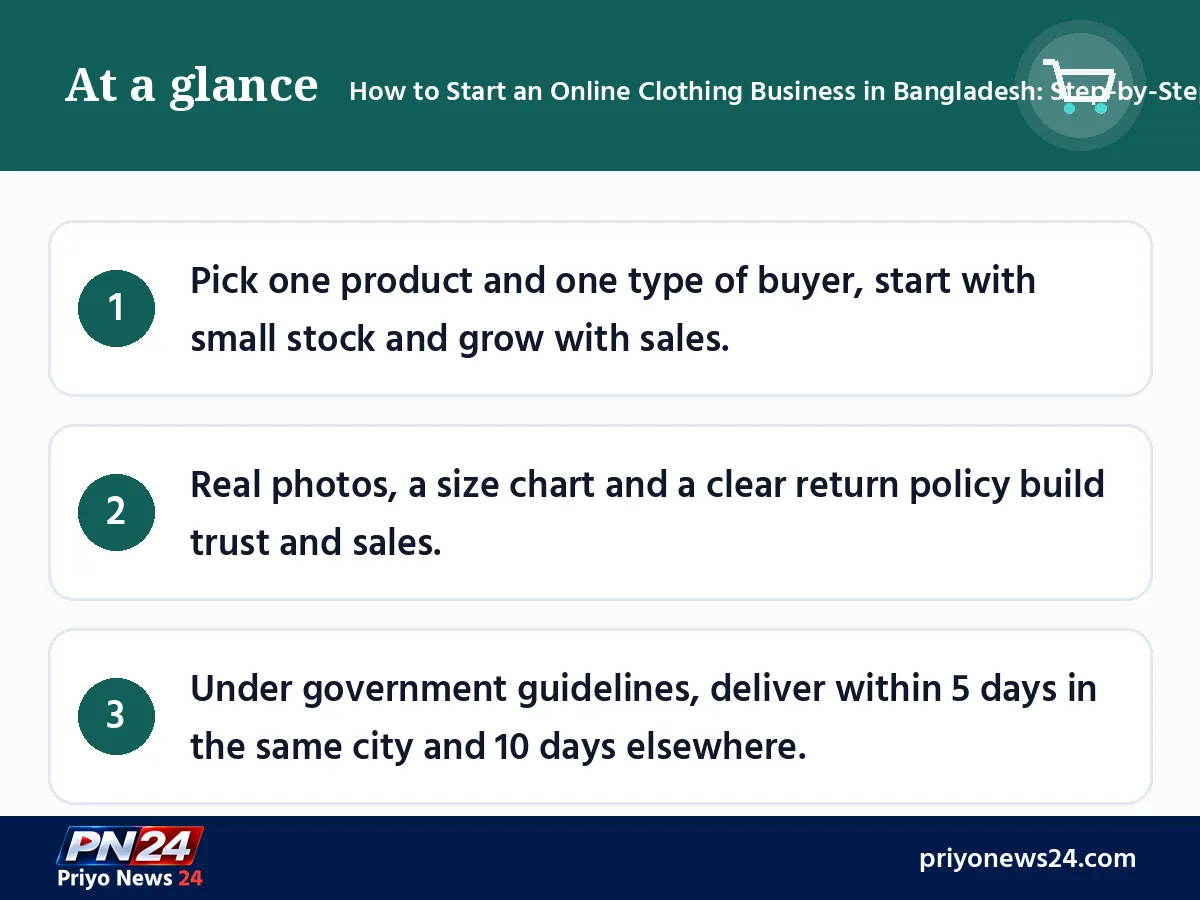
- Pick one product and one type of buyer, start with small stock and grow with sales.
- Real photos, a size chart and a clear return policy build trust and sales.
- Under government guidelines, deliver within 5 days in the same city and 10 days elsewhere.
Eid, Puja, Pohela Boishakh or wedding season: in Bangladesh there is demand for clothes all year round, and a large share of buyers now order after browsing on their phones. That makes an online clothing business one of the most popular ways to start with small capital. But opening a Facebook page and posting photos is not enough. Choosing products, reliable sources, good photos, the right price and on-time delivery together build the business. This guide answers "how do I start an online clothing business" step by step, including the key rules of the government's digital commerce guidelines (applicable as of November 2026).
How to start an online clothing business: 3 decisions first
1. What will you sell?
Starting with "all kinds of clothes" spreads your capital thin and gives your page no identity. Pick one product, for example:
- Handloom or festive sarees
- Women's three-piece sets and kurtis
- Men's panjabis or shirts
- Children's clothing
- Hijabs, orna or shawls
2. Who will you sell to?
Who are your buyers: college students, working women, or parents of newborns? The clearer the buyer, the easier it is to decide photos, prices and ads.
3. Where will your stock come from?
There are three common ways: buying from wholesale markets, sourcing directly from weavers or small factories, or designing your own pieces and having them tailored. Wherever you buy, first test a few samples yourself for fabric quality, colour fastness and stitching. Keep at least two sources instead of relying on one wholesaler.
Online saree business: extra tips
Saree buyers are especially careful about fabric and colour. So:
- Show the full saree, close-ups of the anchal and border, and a photo of it being worn.
- State the fabric (cotton, silk, half silk, etc.), length, and whether a blouse piece is included.
- Shoot in daylight; filters that change colours increase the risk of returns.
- For handloom sarees, honestly state the weaving region; this can be your strongest selling point.
Where to sell: Facebook page, website or marketplace
| Channel | Advantages | Limitations |
|---|---|---|
| Facebook page and groups | Easy start, buyers already there | Depends on the algorithm, managing orders takes time |
| Your own website | Brand, customer data and orders under your control | Some setup cost at the start |
| Online marketplace | Large audience, payments ready | Commission and tough price competition |
Most new entrepreneurs start with a Facebook page and add their own website when orders grow. The Bangladeshi platform eCommerce Autopilot offers a ready website, order management, courier and payments together, so you can run a shop without hiring a programmer. If you want to list products on a marketplace, the local shopping platform PriyoShop is also worth a look.
Setting up your shop step by step
- Name and identity: choose a short, memorable name and use it for your page, Instagram and (later) your domain.
- Photos: shoot near a window in daylight on a white or light background. Give each product at least 3-4 photos.
- Description: clearly state fabric, size, colour, care instructions and price. Avoid "inbox for price"; many buyers leave annoyed.
- Size chart: for three-pieces, kurtis or panjabis, give chest, length and waist measurements. This reduces returns for wrong sizes.
- Pricing: add purchase cost, packaging, ad spend, losses from returned parcels and your profit. Surviving only by being cheaper than others is hard.
- Return policy: write down when items can be returned or exchanged, and within how many days, and pin it on your page.
Orders, payment and delivery
Cash on delivery is still the most common way to sell clothes online in Bangladesh. Offering mobile banking and card payments helps buyers too; to accept cards on a website you need a payment gateway, which usually asks for a trade licence and a bank account.
For delivery, open a merchant account with a well-known courier service; they pick up parcels and send you the cash-on-delivery money later. Call each buyer before shipping to confirm the address and product; this sharply reduces fake orders and returned parcels.
Government rules: Digital Commerce Operation Guidelines 2021
The Ministry of Commerce's Digital Commerce Operation Guidelines 2021 set some obligations for online sellers. According to media reports and law firm analyses, the key points are:
- If buyer and seller are in the same city, the product must be delivered within 5 days; if in different cities, within 10 days.
- If you cannot deliver on time, any advance payment must be refunded within the set period.
- Product details, price, delivery and return conditions must be stated clearly.
- The seller must have a registration or identification number (such as a trade licence).
Once your business is regular, get a trade licence from your city corporation, municipality or union parishad. Check the Ministry of Commerce website for the latest version of the guidelines and any new registration system.
Ways to grow sales
- Post regularly: new collections, short videos of clothes being worn, and photos sent by customers (with permission).
- Prepare before festivals: start stocking and taking pre-orders at least a month before Eid or Puja.
- Live selling: showing clothes on Facebook Live helps buyers understand colour and texture.
- Repeat customers: selling again to old customers is easier and cheaper than finding new ones. Keep their contacts organised.
- Small ad budgets: test ads on a few products with a small amount first, then put more money behind what works.
For more general advice, read our 10 practical online business tips for beginners.
Common mistakes new sellers make
- Buying too much stock: buying many pieces of one design before knowing demand locks up your money. Start small and restock what sells.
- Using other people's photos: selling with photos from another page or brand means buyers find a mismatch, leading to returns and bad reviews. Use your own photos of your own products.
- Not keeping accounts: record daily orders, costs, returns and profit in a notebook or spreadsheet. At month's end you will see which products really earn.
- Slow replies: online buyers expect quick answers. Set fixed times to check your inbox and keep ready replies for common questions.
- Over-promising: if you write "original" or "100% cotton", it must be true. A buyer who loses trust once rarely comes back.
What other businesses can you run online?
Beyond clothing, home-made food, handicrafts, home decor, books and gadget accessories are popular online. Products such as food and cosmetics may have separate quality and approval rules, so learn the rules of the relevant authority before starting. Whatever you choose, the steps in this guide stay much the same: a focused product, reliable sources, good photos, the right price and on-time delivery.
Final word
The secret of an online clothing business is not big capital but trust. Buyers return again and again to a page where photos match the product, prices are clearly written and parcels arrive on time. Start small, learn from every order, keep track of your numbers and grow step by step.
FAQ
How much money do I need to start an online clothing business?
There is no fixed amount; it depends on the product and quantity. Many people start with a small stock of a few designs, or by taking pre-orders. Put most of your capital into products and keep a small separate budget for photos, packaging and ads.
How do I start an online saree business?
Choose one type (such as handloom or festive sarees), find a reliable weaver or wholesaler, photograph each saree in daylight in full and close-up, state the fabric and length, and start selling on a Facebook page or your own website.
Do I need a trade licence for an online business in Bangladesh?
To run a regular, legal business you should get a trade licence from your city corporation, municipality or union parishad. The government's Digital Commerce Operation Guidelines 2021 ask online sellers to have a registration or identification number, and payment gateways and business bank accounts usually require a trade licence too.
What other kinds of business can be done online?
Besides clothes and sarees, home-made food, handicrafts, cosmetics, home decor, books and gadget accessories are popular online. Products like food or cosmetics may have separate quality and approval rules, so check them before you start.
What can I do when buyers order but refuse the parcel?
Confirm new orders by phone, consider taking the delivery charge in advance for outside-Dhaka or expensive orders, and state return conditions clearly in advance. This cuts returned parcels a lot.
Sources
- Dhaka Tribune — E-commerce products have to be delivered within 5-10 days
- Mahbub & Company — Ministry of Commerce issues detailed guidelines on e-commerce business
- VDB Loi — Bangladesh: new rules for e-commerce marketplaces (register, deliver within 5 or 10 days)
- SSLCOMMERZ — How to start an e-commerce business in Bangladesh
- BDIX HOST — Starting an online store in Bangladesh: step-by-step guide
Comments
No comments yet — be the first to comment.