

Iron-Rich Foods List: What to Eat to Beat Anaemia and How to Absorb More Iron

At a glance
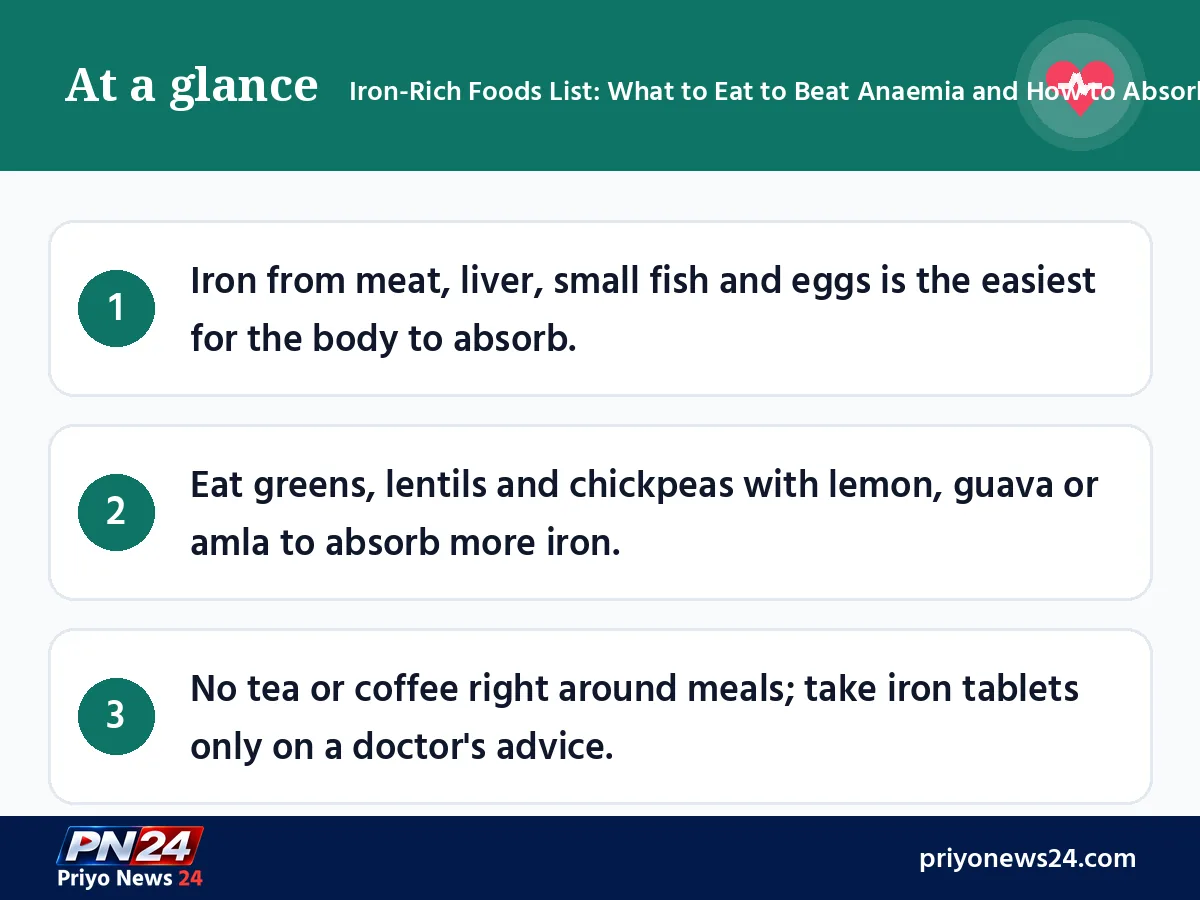
- Iron from meat, liver, small fish and eggs is the easiest for the body to absorb.
- Eat greens, lentils and chickpeas with lemon, guava or amla to absorb more iron.
- No tea or coffee right around meals; take iron tablets only on a doctor's advice.
Tiredness that never lifts, breathlessness after a short walk, a pale face — behind these complaints there is often anaemia, and its best-known cause is a lack of iron. The good news is that everyday Bangladeshi food can supply plenty of iron, as long as you know which foods are richest in it and how to eat them so the body actually absorbs it. This guide covers an iron-rich foods list, tricks to boost absorption, what to avoid and when to see a doctor.
Anaemia and iron deficiency: why it matters
Iron is needed to make haemoglobin, the protein inside red blood cells that carries oxygen from the lungs to every cell in the body. When iron runs low, haemoglobin falls and the cells get less oxygen. The World Health Organization (WHO) estimates that about 40% of children aged 6-59 months, about 37% of pregnant women and about 30% of women aged 15-49 worldwide are anaemic.
The problem is large in Bangladesh too. The national micronutrient survey of 2011-12, carried out by icddr,b with the government, found anaemia in roughly one in three pre-school children and about one in four women who were neither pregnant nor breastfeeding. Interestingly, the same survey found relatively little iron deficiency, and researchers pointed to the natural iron in tube-well water in many areas as one reason. In other words, anaemia in Bangladesh can also come from inherited blood disorders such as thalassaemia, worms or other nutrient gaps — so finding the cause matters as much as fixing the diet.
WHO thresholds: anaemia means haemoglobin below 13 g/dL in adult men, below 12 g/dL in non-pregnant women, and below 11 g/dL in pregnant women and children aged 6-59 months.
Signs of iron deficiency
According to the NHS, common signs include:
- constant tiredness and weakness
- shortness of breath and a pounding heart after light effort
- pale skin
- headaches and ringing in the ears
- a sore tongue, mouth ulcers and hair loss
- cravings for non-food items such as ice, soil or chalk
- brittle or spoon-shaped nails
How much iron do you need a day?
The UK's National Health Service (NHS) recommends these daily amounts for adults:
| Who | Iron per day (approx.) |
|---|---|
| Men aged 19-64 | 8.7 mg |
| Women aged 19-50 | 14.8 mg |
| Women over 50 | 8.7 mg |
Women need more because they lose blood, and with it iron, every month during their periods. In pregnancy the need rises further for the baby's growth, so WHO recommends a daily iron and folic acid supplement for pregnant women, with the dose set by a doctor.
Iron-rich foods list (everyday Bangladeshi food)
Food iron comes in two forms. Haem iron comes from animal foods such as meat, fish and eggs, and the body absorbs it easily. Non-haem iron comes from plant foods such as greens, lentils and nuts; it is absorbed less well, but the right food partners can raise absorption a lot.
| Food group | Local examples | Tip |
|---|---|---|
| Meat and liver | beef, mutton, chicken liver | small portions a few times a week; no liver in pregnancy |
| Fish | small fish such as mola, dhela and kachki | eaten with the bones, they give both iron and calcium |
| Eggs | chicken and duck eggs | eat the whole egg, well cooked |
| Green leafy vegetables | taro leaves (kochu shak), red amaranth (lal shak), spinach, Malabar spinach (pui shak), amaranth stems and radish leaves | cook with tomato or squeeze lemon over them |
| Pulses and seeds | red lentils, mung, chickpeas, kidney beans, soybeans | soaking or sprouting helps digestion and absorption |
| Nuts and dried fruit | peanuts, sesame, dates, raisins | a handful as a snack |
| Fortified foods | iron-fortified flour or cereal | check the label |
A simple day might look like this: an egg and roti with a guava for breakfast; rice, small fish, red amaranth and lentils with lemon for lunch; spiced chickpeas or a handful of nuts in the afternoon; meat or lentils with vegetables and a tomato salad for dinner.
6 ways to absorb more iron
Eating iron is not enough — the body has to take it in. Based on NHS and hospital nutrition leaflets:
- Pair it with vitamin C. Lemon, guava, amla, orange, tomato or green chilli boost the absorption of plant iron. Squeezing lemon over greens and lentils is the easiest trick.
- Mix plant and animal foods. A little fish or meat on the plate also helps the body take more iron from greens and lentils.
- Keep tea and coffee away from meals. Their tannins reduce iron absorption. Drink them at least an hour before or after eating.
- Separate milk and calcium. Milk, yoghurt and calcium tablets interfere with iron absorption, so avoid having them with your main iron-rich meal.
- Soak your pulses and grains. Soaking, sprouting or fermenting reduces phytates, so more iron becomes available.
- Eat it regularly. A source of iron at every meal works better than a large amount once in a while.
Who is most at risk
- teenage girls and women of reproductive age, especially those with heavy periods
- pregnant and breastfeeding mothers
- children from 6 months to 5 years whose complementary food is low in iron
- people who eat no fish or meat at all
- people with regular blood loss from worms, piles or ulcers
- regular blood donors
Iron tablets: be careful
If diet alone is not enough or the deficiency is severe, a doctor may prescribe iron tablets. The NHS notes they can cause black stools, constipation or stomach upset, which are usually harmless. Keep these points in mind:
- Do not buy and take them on your own. If the anaemia is due to thalassaemia trait or another cause, extra iron can build up in the body and cause harm.
- A doctor will check haemoglobin and iron stores (such as ferritin) to find the cause.
- Keep iron tablets out of children's reach; an overdose is dangerous for a child.
- Do not stop the course early on your own, and get a repeat blood test afterwards.
Common myths
- "Beetroot or pomegranate juice builds blood." These are healthy, but they are not major iron sources. Meat, small fish, eggs, greens and lentils do far more.
- "If I don't look pale, I'm not anaemic." Mild anaemia often has no visible signs; a blood test is the only way to know.
- "Extra iron can't hurt." Too much iron from food is unlikely, but too many tablets can cause stomach problems and iron build-up.
- "Vegetarians can't get enough iron." With enough lentils, chickpeas, soybeans, greens, nuts and sesame, plus vitamin C, a vegetarian diet can meet the need.
When to see a doctor
See a doctor without delay if tiredness, breathlessness or palpitations last a long time, if your periods are unusually heavy, if you see blood in your stool or black stools (when not taking iron tablets), or if you are pregnant. If thalassaemia runs in your family, a blood test before marriage or before planning a child is a wise step.
Final word
Fixing iron deficiency doesn't need expensive food. Taro leaves, red amaranth, small fish, eggs, lentils and a slice of lemon — the answer is already in our kitchens. Three rules matter most: include a source of iron at every meal, add vitamin C, and keep tea and coffee away from mealtimes. But if you have signs of anaemia, don't rely on food alone — get a blood test.
This article is for general awareness and reflects WHO and NHS guidance as of November 2026. Talk to a doctor about your own health.
FAQ
What should I eat if I have anaemia?
Iron-rich foods: meat, small fish, eggs, liver (not during pregnancy), taro leaves, red amaranth, spinach, red lentils, chickpeas and nuts. Add vitamin C foods such as lemon, guava, amla or tomato. But get a blood test first to find out what is causing the anaemia.
How much iron do I need a day?
According to the UK's NHS, men aged 19-64 need about 8.7 mg a day, women aged 19-50 about 14.8 mg and women over 50 about 8.7 mg. Needs rise in pregnancy, when doctors usually prescribe a supplement.
Does tea reduce iron absorption?
Yes. The tannins in tea and coffee reduce how much iron the body takes from plant foods. Leave at least an hour between your meal and your cup of tea.
Can I buy iron tablets and take them myself?
No. Not all anaemia is caused by a lack of iron; thalassaemia carriers and people with other conditions can also have low haemoglobin, and extra iron can then do harm. Get a blood test and let a doctor decide the dose.
What haemoglobin level counts as anaemia?
By WHO thresholds, anaemia means haemoglobin below 13 g/dL in adult men, below 12 g/dL in non-pregnant women, and below 11 g/dL in pregnant women and children aged 6-59 months.
Sources
- WHO — Anaemia fact sheet
- NHS — Iron deficiency anaemia
- NHS — Iron deficiency anaemia: causes
- NHS Blood and Transplant — Iron in your diet
- Patient.info — Diets suitable for people with anaemia
- icddr,b — National Micronutrients Status Survey 2011-12
- Journal of Nutritional Science — Micronutrient deficiencies among children and women in Bangladesh
Comments
No comments yet — be the first to comment.