

When a Migrant Worker Dies Abroad: Family Guide to Repatriation, the Tk 3 Lakh Grant and Compensation

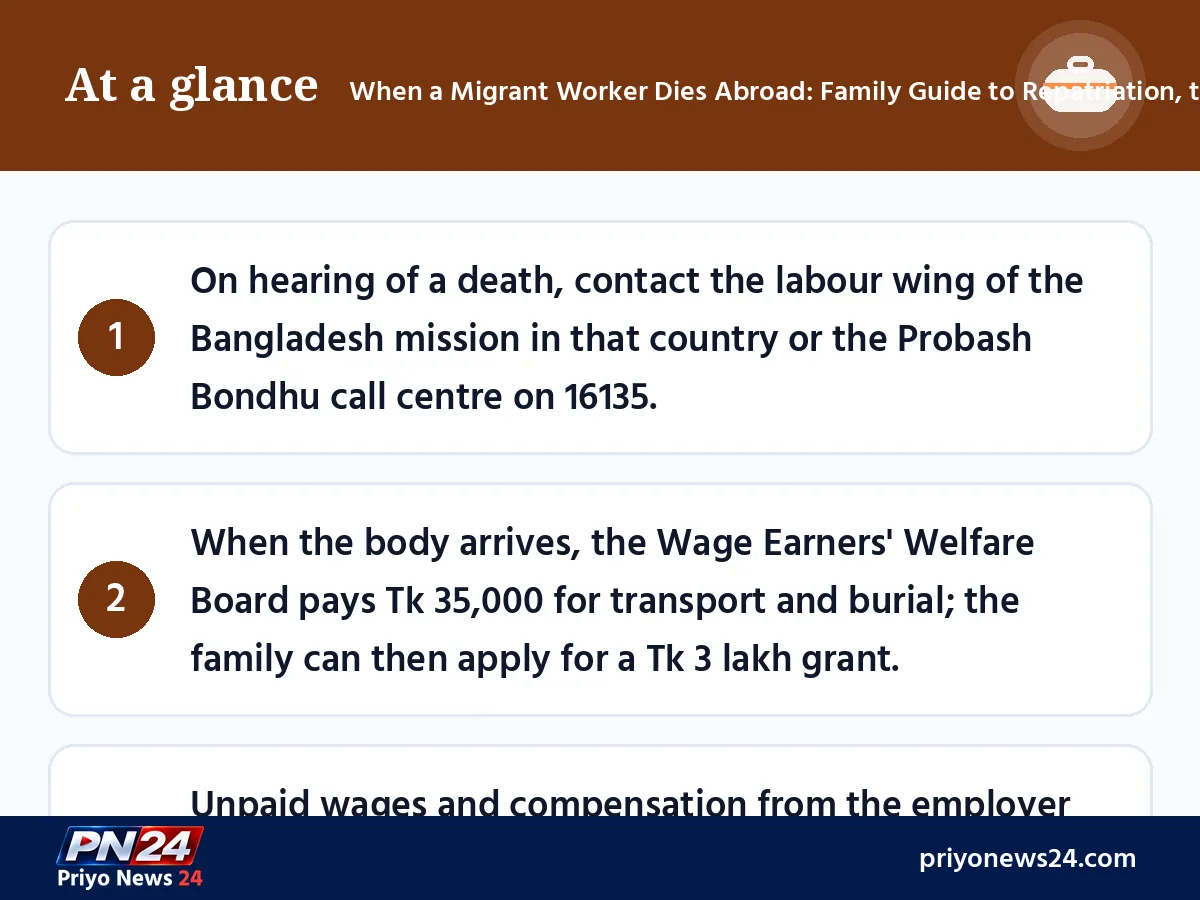
At a glance
- On hearing of a death, contact the labour wing of the Bangladesh mission in that country or the Probash Bondhu call centre on 16135.
- When the body arrives, the Wage Earners' Welfare Board pays Tk 35,000 for transport and burial; the family can then apply for a Tk 3 lakh grant.
- Unpaid wages and compensation from the employer abroad are collected by the mission and paid to the heirs through the welfare board.
News that a loved one has died abroad is the hardest moment a family can face. In the middle of grief they must arrange for the body to come home, the burial and the recovery of unpaid money, and many do not know where to start. A Prothom Alo report found that on average more than 14 migrants' bodies return to Bangladesh every day. That is why it helps to know in advance what a family should do when a migrant worker dies abroad. This guide is based on information published by the Wage Earners' Welfare Board and the media up to November 2026.
First steps after hearing the news
The news usually comes from a colleague, the employer or the Bangladesh mission. Write down a few details straight away:
- The deceased's full name and passport number
- The country, city and date of death
- The employer's name and contact number
- Which hospital or place the body is now in
- The name and phone number of the person who called you
Then contact the labour wing of the Bangladesh embassy or consulate in that country as soon as possible. From Bangladesh you can also call the Probash Bondhu call centre of the Ministry of Expatriates' Welfare on 16135 for advice. Give one family member the job of handling contacts so that different people do not pass on conflicting information.
Bringing the body home or burial abroad
The family must decide whether the body comes home or is buried in the host country. The mission usually asks for the opinion or written consent of the legal heirs. If there is doubt about the cause of death, tell the mission in writing, because an investigation or post-mortem may take place under local law and that can take time.
Repatriation is normally arranged between the employer and the mission. If a broker asks for money or promises to "send it quickly", check directly with the mission. The death certificate and other papers travel with the body; keep copies, because you will need them for the grant and compensation claims.
Government support: how much and when
The Wage Earners' Welfare Board is the government body for migrant workers' welfare. According to its website and media reports, the family of a deceased worker receives financial help in two stages:
| Support | Amount | When and where |
|---|---|---|
| Body transport and burial | Tk 35,000 | At the airport when the body is received |
| Financial grant | Tk 300,000 | After application and verification |
| Total | Tk 335,000 | — |
An Ajker Patrika report on the bodies of 9 migrants who arrived from Riyadh said each family was getting Tk 3.35 lakh in total. This support is mainly for workers who left with emigration clearance or are welfare board members.
Receiving the body at the airport, step by step
- Get the flight details: ask the mission or employer for the flight number, date and air waybill number.
- Bring identification: the close relative receiving the body should carry their national ID card and the deceased's passport or a copy.
- Go to the welfare board desk: introduce yourself at the Wage Earners' Welfare Board's expatriate welfare desk at the airport. The Tk 35,000 for transport and burial is paid here.
- Collect the papers: take all documents that came with the body, including the death certificate, and make copies.
- Arrange transport: book a suitable vehicle in advance to take the body home.
How to apply for the Tk 3 lakh grant
After the burial, the family can apply for the financial grant. The District Employment and Manpower Office of the deceased's home district receives the application; several district offices list this service on their websites. Documents usually required:
- The prescribed application form
- The death certificate issued abroad, with a copy
- Copies of the deceased's passport and emigration clearance
- A succession (heirship) certificate from the union parishad or municipality
- Copies of national ID cards and photographs of the applicant and heirs
Get the current list from the district office before applying. The grant is shared among the legal heirs, so make sure every name on the succession certificate is correct. Do not agree to pay anyone who offers to "get the money out quickly" for a commission; the family can apply on its own.
Dues and death compensation from abroad
Beyond the government grant, the employer abroad may owe the deceased unpaid wages, end-of-service benefits, insurance or compensation for a workplace death. The mission's labour wing is responsible for collecting these. The money is then sent home, and the Wage Earners' Welfare Board verifies and distributes it among the legal heirs. According to The Daily Star, such compensation also earns the 2.5% remittance incentive when it comes home through legal channels.
This can take months or even years. Note the reference number of any application made to the mission, follow up regularly and contact the welfare board or 16135 when needed.
Beware of fraud during grief
Sadly, families of deceased migrants are sometimes targeted by fraudsters. Someone may pose as an official from the mission, the airport or the welfare board and say "a fee is needed to release the compensation" or "give us your bKash number and PIN". Remember:
- No bribe or commission is needed to receive a government grant or compensation.
- No government office asks for a mobile wallet or bank PIN over the phone.
- Note down any suspicious number and check with 16135 or the district manpower office.
- Never hand over original documents; give attested copies if needed.
Other tasks after the burial
Once the first shock has passed, sort out a few more matters. If the deceased had a bank account, savings certificates or a mobile wallet in Bangladesh, start the process of transferring the money to the heirs by submitting the death and succession certificates. If there is a loan from Probashi Kallyan Bank or elsewhere, inform the lender in writing and ask what happens to it. If colleagues abroad hold the deceased's belongings or money, ask the mission to help return them.
Preparation that protects families
- Migrate legally: leaving with emigration clearance makes it easier to be covered by welfare board benefits.
- Secure membership: workers who left without clearance, or are unsure about their membership, can join the welfare board from abroad through Bangladesh missions such as those in Doha and Canberra.
- Give copies to the family: leave copies of the passport, visa, contract and employer's address at home.
- Heirs: let the family know who the heirs are to avoid disputes over the succession certificate later.
- Children's scholarships: the welfare board also offers scholarships for migrant workers' children; apply when the notice is published.
Final word
No payment can make up for losing a loved one abroad, but contacting the right places can at least spare the family financial and legal trouble. Remember four contacts: the mission's labour wing, the welfare desk at the airport, the District Employment and Manpower Office and the Probash Bondhu call centre on 16135. Grant amounts and document lists can change, so check the latest details on the welfare board's website or with the district office before applying.
FAQ
Does the family have to pay to bring a migrant's body home?
The body is usually sent home with the help of the employer or the Bangladesh mission. On arrival, the Wage Earners' Welfare Board pays Tk 35,000 at the airport for transport and burial. If there are problems with costs, tell the mission's labour wing.
How much does the government give when a migrant worker dies?
The Wage Earners' Welfare Board gives Tk 35,000 for transport and burial and then a Tk 3 lakh financial grant, Tk 3.35 lakh in total. Compensation from the employer or insurance abroad may be paid separately.
Where do we apply for the Tk 3 lakh grant?
At the District Employment and Manpower Office of the deceased worker's home district. Get the current document list from that office or the welfare board's website.
Can the family of a worker who went abroad irregularly get the grant?
Welfare board benefits are mainly for workers who left with emigration clearance or are board members. Workers abroad can join through Bangladesh missions, so it is important to secure membership in advance if papers are not in order.
How is death compensation from abroad claimed?
The mission's labour wing collects unpaid wages, end-of-service benefits or accident compensation from the employer and sends it home. The Wage Earners' Welfare Board verifies the heirs and distributes the money.
Sources
- Wage Earners' Welfare Board: Body transport and burial costs
- Wage Earners' Welfare Board: Financial grant
- Wage Earners' Welfare Board: Death compensation
- District Employment and Manpower Office, Bogura: Financial grant
- Ajker Patrika: Bodies of 9 migrants arrive from Riyadh, families get Tk 3.35 lakh
- Migration Concern: Government gives Tk 3 lakh to families of deceased migrant workers
- Prothom Alo English: Over 14 bodies return home every day on average
- The Daily Star: BB offers 2.5% incentive on remitting compensation
- Embassy of Bangladesh, Doha: Wage Earners Welfare Board Membership Registration
- The Daily Star: Wage Earners' Welfare Board: Expatriates signing up to get benefits
- The Financial Express: Stipends elude migrant workers' children
Comments
No comments yet — be the first to comment.