

Sales Psychology: 9 Honest Ways to Increase Sales by Understanding Your Buyers

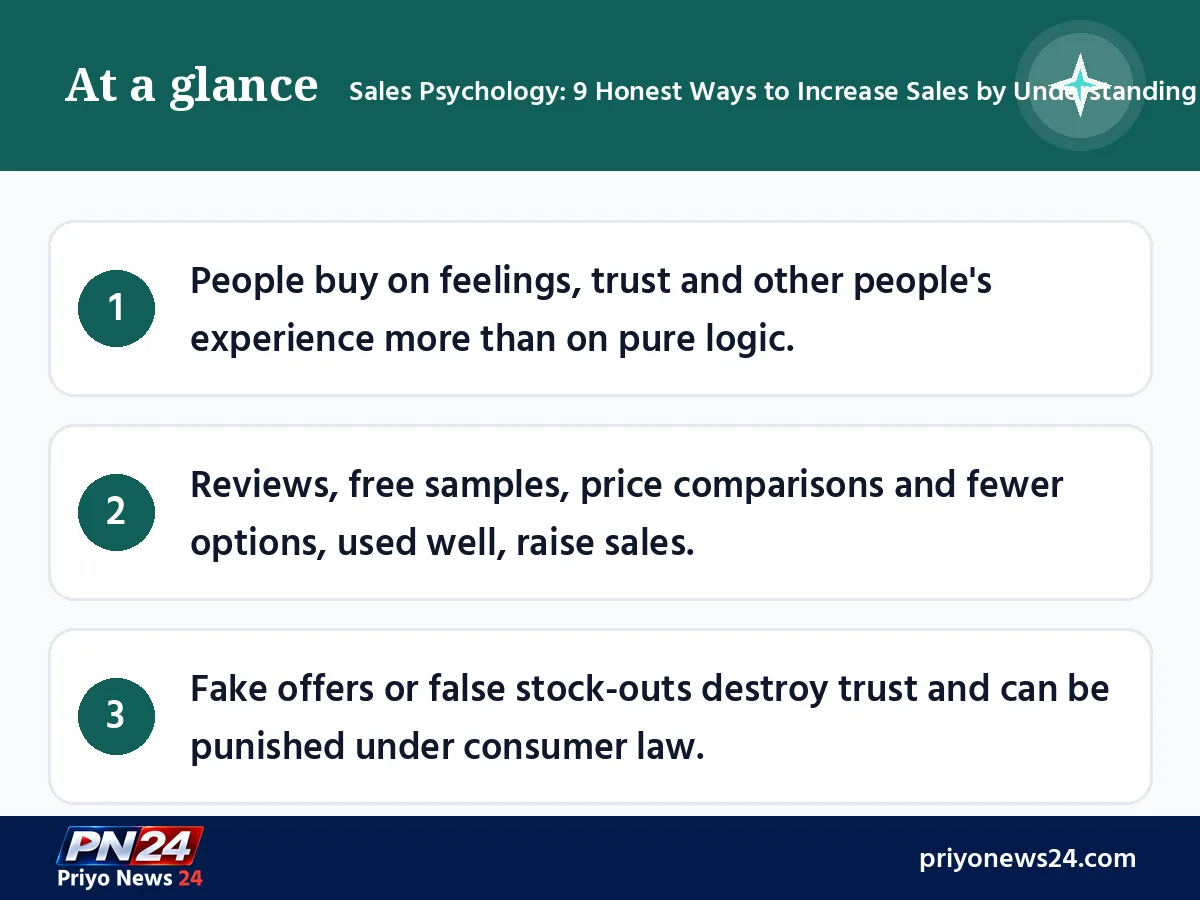
At a glance
- People buy on feelings, trust and other people's experience more than on pure logic.
- Reviews, free samples, price comparisons and fewer options, used well, raise sales.
- Fake offers or false stock-outs destroy trust and can be punished under consumer law.
Same product, same price, yet one shop is crowded while the shop next door is empty. Facebook pages show the same pattern: one seller gets 50 orders a day, another gets 5 in a week. A large part of the difference lives in the buyer's mind. People do not buy on arithmetic alone; trust, habit, other people's experience and the feeling of the moment shape the decision too. Sales psychology means understanding these patterns and arranging your product, price and message so the right buyer can decide easily.
This guide explains the 9 best-tested techniques from behavioural science and marketing research, with examples from small shops and online businesses in Bangladesh. It also covers where to stop: the legal and ethical limits.
Why sales psychology works
American psychologist Robert Cialdini showed in his well-known book "Influence" that people use mental shortcuts when they decide. He first described 6 principles and later added a seventh: reciprocity, commitment and consistency, social proof, authority, liking, scarcity and unity.
Behavioural economics adds a few more ideas: anchoring (the pull of the first number we see), loss aversion, the decoy effect and choice overload. None of these is magic. Without a good product no technique keeps sales up for long. But with a good product, they remove the buyer's hesitation.
9 psychological techniques to increase sales
1. Social proof: show that others are buying
When people see a new shop or page, their first question is "Can I trust them?" Reviews from other buyers, photos of received parcels and unboxing videos answer it.
- After every delivery, send a short message asking for a review.
- Use real screenshots with permission, and blur names and phone numbers.
- If you write "120 people bought this month", the number must be true.
2. Reciprocity: give something first
People like to return a favour. A sweet shop that lets you taste, a small cosmetics sample, or a free size chart or how-to video online all work on this principle. Make sure the gift is truly useful and has no hidden conditions.
3. Small commitments lead to big decisions
Someone who takes one small step tends to keep going in that direction. On a page, "Tell us your size and we will match it for you" works better than "Comment for price", because the buyer describes their own need. Trial packs and small sizes do the same job.
4. Show authority and expertise
People trust experts. Mention how many years of experience you have, quality certificates (such as BSTI where it applies) and accurate details of the fabric or ingredients. Never use fake certificates or invented "doctor's advice".
5. Liking and unity: people buy from people they know
Buyers feel comfortable buying from someone they like or see as "one of us". Videos of the owner speaking, local language, and stories of people from the same area or profession build this bond. Cialdini added "unity" as his seventh principle for exactly this "we are on the same team" feeling.
6. Anchoring: the first number sticks
Buyers compare every later price with the first one they see. Show the premium package first and the regular package then looks affordable. If you show an old price crossed out, that old price must really have been in use for a while.
7. Decoy pricing: the magic of three options
In a widely discussed experiment by behavioural economist Dan Ariely, adding a less attractive middle option made far more people choose the expensive full package. This is called the decoy effect. Example: a tea shop prices 250 g at Tk 180, 500 g at Tk 340 and 1 kg at Tk 360; most buyers will take the 1 kg pack. (The prices are only an example.) It does not work in every situation, so test it on your own page.
8. Fewer options, faster decisions
In the jam study by psychologists Sheena Iyengar and Mark Lepper, a store displayed 24 jams one time and 6 jams another time. More people stopped at the big table, but far fewer bought; the small table produced roughly ten times the purchase rate. Later research did not always repeat the result, yet the lesson is useful: instead of showing 100 products in your first post or on your home page, bring your best 3-5 to the front and keep the rest in categories.
9. Loss aversion and real scarcity
People feel a loss more strongly than a gain of the same size. Facts such as "last delivery before Eid is Thursday" or "only 30 pieces in this lot", when true, help buyers decide in time. But writing "last day today" every day teaches buyers to ignore you and destroys trust.
Content psychology: a structure for posts that sell
When you write a Facebook post, a reel script or a product description, follow this order:
- Start with the problem: "Lips cracking in winter?" Buyers keep reading when they recognise their own problem.
- Solution and proof: how the product helps, with real photos and reviews.
- Clear information: price, size, delivery charge, time and return policy. Hiding the price makes many buyers leave without messaging you.
- Lower the risk: cash on delivery, checking the product on arrival, or replacement if it is damaged.
- One clear call to action: "Message your name, address and phone number to order". Several instructions at once confuse people.
| Technique | Good use | Avoid |
|---|---|---|
| Social proof | Real reviews and photos | Bought likes or invented reviews |
| Scarcity | Genuinely limited stock | "Last chance" every day |
| Anchoring | A real old price or package comparison | An "old price" that never existed |
| Authority | Real certificates and experience | Fake certificates or expert names |
Legal and ethical limits in Bangladesh
Under Bangladesh's Consumer Rights Protection Act 2009, deceiving buyers with false or misleading advertising is a punishable offence. Short weight, failing to deliver the promised product or service, and charging more than the fixed price are offences under the same law. Complaints can be filed with the Directorate of National Consumer Rights Protection, and the law provides that when a complaint is proven and a fine is collected, the complainant receives 25 percent of the amount. Proposals to update the law have also been discussed, so check the provisions in force as of November 2026 on the directorate's website.
A simple rule: never advertise a claim you could not prove standing in front of the buyer. Psychology is for understanding buyers, not trapping them. A cheated buyer buys once; a satisfied buyer comes back and brings friends.
A small 30-day test plan
- Week 1: Collect at least 10 reviews from past buyers and highlight them on your page.
- Week 2: Cut your range on the front and pin or feature your best 5 products.
- Week 3: Build three packages for one product and see which sells most.
- Week 4: Rewrite your posts in the problem, solution, proof, call-to-action order.
Each week, note how many people messaged and how many ordered. The numbers will show which techniques work for your buyers. For more steps, read How to Grow a Small Business and How to Get Your First 100 Customers.
Final word
Sales psychology is mostly the habit of standing in the buyer's shoes. Build trust, make the decision easy, keep prices clear and keep your promises. Do these four things consistently and sales can grow without a bigger ad budget.
FAQ
What does sales psychology mean?
It means understanding how buyers make decisions, what builds their trust and what makes them hesitate, and then arranging your product, price and message around that. The goal is to make choosing the right product easier, not to trick anyone.
How does content psychology increase sales?
Start a post or video with the buyer's problem, show the solution, add real customer reviews and photos, keep price and delivery details clear, and finish with one clear call to action such as 'message us to order'. This lets people decide faster.
Does showing more products increase sales?
Not always. In a famous jam study, a table with 6 jams produced far more purchases than a table with 24. Later studies did not always find the same effect, but offering new buyers a small, curated set of options is usually the safer choice.
Are limited-time offers legal?
Real ones are. But deceiving buyers with false or misleading advertising is an offence under Bangladesh's Consumer Rights Protection Act 2009 and can lead to a fine or jail. Make sure every claim you make is true.
Which technique should a small online shop start with?
Start by collecting and showing genuine customer reviews. It costs nothing and builds trust. Then cut your front-page range to your best 3-5 products and show packages or comparisons next to the price.
Sources
- Wikipedia: Robert Cialdini
- CXL: How to Use Cialdini's 7 Principles of Persuasion to Boost Conversions
- ASU W. P. Carey: The gentle science of persuasion, part seven: Unity
- Econsultancy: Want more sales? Give consumers fewer options
- arXiv: A Better Test of Choice Overload
- Wikipedia: Decoy effect
- bdlaws: Consumer Rights Protection Act 2009
- BSS: Consumer rights law penalises offenders, awards complainants 25pc of realised fines
Comments
No comments yet — be the first to comment.