

University Admission Test Preparation: Plan, Routine and Strategy

At a glance
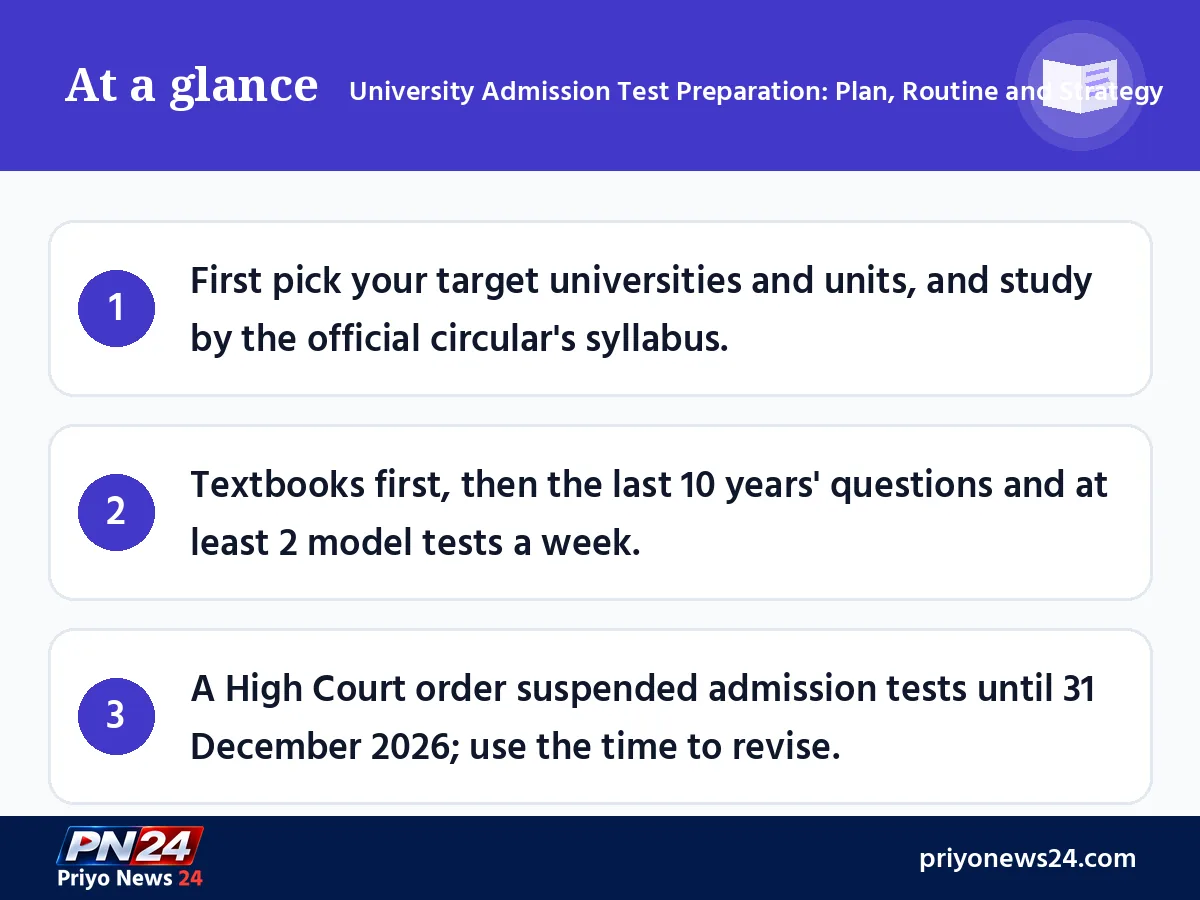
- First pick your target universities and units, and study by the official circular's syllabus.
- Textbooks first, then the last 10 years' questions and at least 2 model tests a week.
- A High Court order suspended admission tests until 31 December 2026; use the time to revise.
After HSC, one of the biggest competitions in a student's life is university admission test preparation. Public universities, engineering, agriculture and cluster universities have far more applicants than seats, so hard work alone is not enough; you need a plan. This guide takes you step by step from choosing targets to a daily routine, past papers, model tests and exam-hall strategy.
The 2026 situation: what to know first
On 18 November 2026, the High Court ordered all public universities, including Dhaka University, to suspend first-year undergraduate admission tests until 31 December. Prothom Alo, Dhaka Tribune and Daily Sun reported that the order aims to stop admission tests before HSC re-scrutiny and re-exam results are published. bdnews24.com reported that BUET then postponed its admission test.
This means new schedules are not yet final (as of 21 November 2026). You have gained a few extra weeks. Don't panic; treat the time as a chance to revise and strengthen weak chapters. For dates, follow only your university's official website and notices, not Facebook rumours.
Step 1: choose targets and understand the admission system
Public university admission in Bangladesh comes in a few forms:
| Type | Examples | What to remember |
|---|---|---|
| Own unit-based tests | Dhaka University and some other large universities | Each unit has its own syllabus and eligibility |
| Engineering | BUET, the engineering cluster (CUET-KUET-RUET) | Deep preparation in maths, physics and chemistry |
| Cluster system | GST cluster, agriculture cluster | One test for several universities |
| Universities outside the cluster | Several universities | Hold their own separate tests |
According to The Financial Express and The Daily Campus, several universities have left the GST cluster in recent years to hold their own tests. So check each year's new circular to see which university uses which system.
An easy way to set targets:
- List your group (science, humanities, business studies) and preferred subjects.
- Pick 3-5 target tests: one dream, two realistic, one safe option.
- From each one's latest circular, note the GPA requirement, syllabus, mark distribution and negative-marking rules in a notebook.
Step 2: a preparation plan and routine
Split the time you have into three phases:
| Phase | Share of time | Work |
|---|---|---|
| Foundation | about the first 50% | Read HSC textbooks line by line, notes on formulas and definitions |
| Practice | about the next 30% | Past years' questions, chapter-wise MCQs |
| Final | about the last 20% | Full model tests, revising your mistakes notebook |
A sample daily routine (about 8-9 hours of study):
- Morning: the hardest subject (such as maths or accounting) for 3 hours
- After lunch: a second subject for 2-3 hours, with a 10-minute break
- Afternoon: a walk or light exercise, rest
- Evening: English/Bangla and general knowledge for 2 hours
- Night: revise the day's study and solve 30-50 MCQs
Keep one day a week just for revision and a full model test. Sleep at least 7 hours a night; less sleep weakens memory.
Step 3: subject-wise strategy
- Textbooks first: most questions come from the national curriculum HSC books. Guidebooks and question banks are not a substitute.
- Analyse past papers: solve at least the last 10 years' questions of your target university. Mark the chapters that come up again and again.
- Science group: practise physics and chemistry formulas and numerical problems every day; in biology, focus on diagrams and definitions.
- Humanities and business studies: keep Bangla grammar, English grammar and vocabulary, and the basics of accounting and management clear.
- English: 10-15 new words a day, the grammar parts of past papers and one short passage.
- General knowledge: for units that test it, note important news and basic facts about Bangladesh every day.
- Written part: where there is a written test, practise writing within the set time.
Step 4: model tests and exam-hall strategy
Model tests are not just for seeing your score; they are for finding mistakes. After every test, write in a "mistakes notebook" which question you got wrong and why, and revise it at the end of the week.
In the exam hall:
- First, quickly finish the questions you are sure about.
- Don't get stuck on hard questions; come back to them later.
- If there is negative marking, don't answer unless you are sure.
- Fill in your roll, unit and set code correctly on the OMR sheet; a mistake here can ruin the whole exam.
- Keep the last 5 minutes just for checking the OMR sheet.
Mistakes to avoid
- Starting many guidebooks at once and finishing none
- Studying only favourite subjects and avoiding weak ones
- Forgetting the application deadline or paying the fee late
- Studying all night and being tired during the day
- Losing morale by comparing yourself with others every day
The last 30 days
In the final month, don't start anything new; consolidate what you have studied:
| When | What to do |
|---|---|
| 30-15 days before | A full revision of one subject a day, a model test every other day |
| 15-7 days before | One full model test a day, revision from your mistakes notebook |
| Last 7 days | Only formulas, notes and repeatedly missed questions; no new books |
| Day before the exam | Light revision, pack your admit card and pens, a full night's sleep |
Exam-day checklist
- Printed admit card (two copies is safer) and any ID the circular asks for
- 2-3 black ballpoint pens; check the circular on whether a calculator or other items are allowed
- Visit the centre the day before, and leave at least 1 hour early to allow for traffic
- A light snack and water; phones are usually not allowed in the hall, so leave yours with a guardian
Managing stress and health
Postponed dates and uncertainty, as this year, raise anxiety for many students. To ease stress, walk 20-30 minutes a day, eat on time, and stay away from admission rumours on social media and posts about "how many hours I studied". Talk openly with your family; parents should encourage their children instead of comparing them. If you cannot sleep for a long time or feel intense anxiety, seek help from a doctor or counsellor.
Applying, documents and a backup plan
When the admission circular comes out, apply online within the deadline, and download and print the fee receipt and admit card. Keep your SSC and HSC roll and registration numbers, a recent photo and a working mobile number ready in advance.
Not everyone gets their first choice, and that is not failure. Colleges affiliated with the National University, the various clusters and recognised private universities are also good options. Keeping a backup list in advance reduces stress after results come out.
Conclusion
Success in admission tests comes from regular study, analysing past papers and learning from model-test mistakes. Use the extra time you have this year to revise, look after your body and sleep, and trust only official notices for dates. Priyo News 24 will report the new admission schedules as soon as they are announced.
FAQ
When should I start preparing for university admission tests?
Ideally, studying the HSC textbooks well already covers half of admission preparation. Start full preparation the day after your HSC exams end. There are usually a few months between results and admission tests, which you need to plan carefully.
Can I get a seat without coaching?
Yes, many students do. Coaching mainly provides structure, a routine and model tests. With regular textbook study, past-paper practice and timed model tests, good preparation is possible without coaching. Take online classes or a teacher's help for weak subjects if needed.
Is there negative marking in admission tests?
Many universities deduct marks for wrong MCQ answers, but the rules differ by university and by year. Check the mark distribution and negative-marking rules in the latest admission circular of your target university. If there is negative marking, avoid guesswork.
When will admission tests be held in 2026?
On 18 November 2026, the High Court ordered public universities to suspend admission tests until 31 December, until HSC re-scrutiny and re-exam results are published. Each university will announce new dates separately. Follow only official university websites and notices.
How do I split preparation between cluster and separate tests?
Put the syllabuses side by side and find what they share; in most cases the HSC textbooks are the core. Strengthen that common part first, then prepare separately for each test's extras, such as written questions or general knowledge.
Sources
- Prothom Alo English — High Court suspends admission tests at all public universities until 31 December
- Dhaka Tribune — HC suspends university admission tests until HSC re-scrutiny results
- Daily Sun — Public university admission tests suspended until 31 December
- bdnews24.com — High Court order pushes back BUET admission test as Dhaka University prepares appeal
- The Financial Express — Four universities leave GST cluster admission test system
- The Daily Campus — Five universities stay out of GST cluster admission again
- Teachers' Portal (teachers.gov.bd) — Information for Dhaka University admission
Comments
No comments yet — be the first to comment.