

Virtues of Friday (Jumu'ah) and Its Sunnah Acts in Authentic Hadith

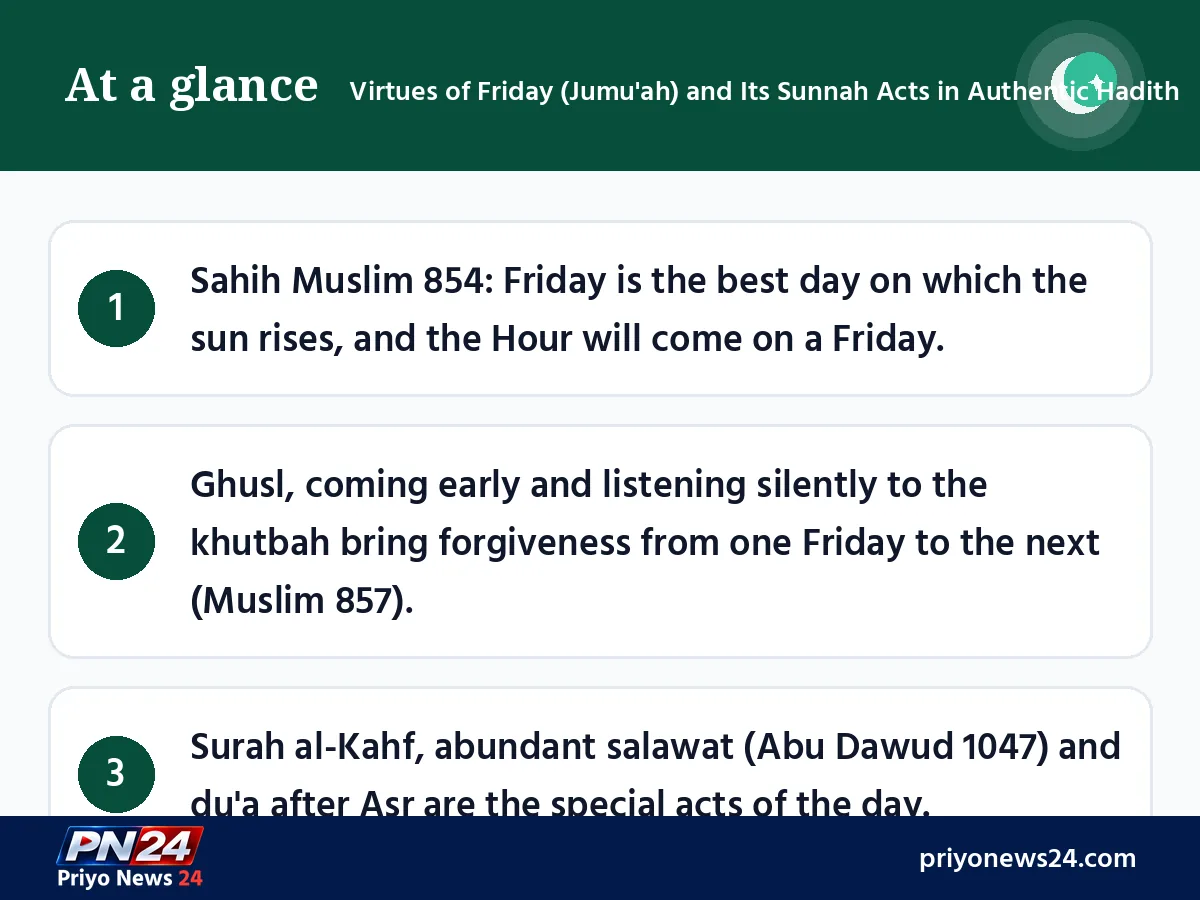
At a glance
- Sahih Muslim 854: Friday is the best day on which the sun rises, and the Hour will come on a Friday.
- Ghusl, coming early and listening silently to the khutbah bring forgiveness from one Friday to the next (Muslim 857).
- Surah al-Kahf, abundant salawat (Abu Dawud 1047) and du'a after Asr are the special acts of the day.
The virtues of Friday are among the most encouraging teachings for Muslims. In Bangladesh Friday is the weekly holiday, so many people spend it with family, at the market or simply resting. Yet the hadith call Friday the best day of the week, and it comes with a set of simple acts that carry great reward. This guide brings together the virtues of Friday, the sunnah acts of Jumu'ah and the things to avoid, all with references to authentic hadith, in plain language.
One note first: many narrations about Friday circulate online, and some of them are weak or baseless. This article mainly relies on Sahih al-Bukhari, Sahih Muslim and reports graded authentic by scholars. If you are unsure about a narration, check it with a trusted scholar.
Virtues of Friday: what the hadith say
The best day of the week
In Sahih Muslim (854), Abu Hurayrah reports that the Prophet (peace be upon him) said the best day on which the sun rises is Friday. On it Adam was created, on it he was admitted to Paradise, on it he was sent out of it, and the Hour will be established on no day other than Friday.
The Qur'anic command
In Surah al-Jumu'ah, verses 9 and 10, Allah tells the believers that when the call to prayer is made on Friday they should hurry to the remembrance of Allah and leave off trade. Once the prayer is over they may disperse in the land, seek Allah's bounty and remember Him often. Islam asks for that window of time to be devoted to worship and then permits a return to work.
A weekly chance of forgiveness
Sahih Muslim (233) reports that the five daily prayers, and one Jumu'ah to the next, expiate the sins between them as long as major sins are avoided. Another narration (Muslim 857) says that whoever performs ghusl, comes to Jumu'ah, prays what he is able to, stays silent until the khutbah ends and prays with the imam, is forgiven what is between that Friday and the next, plus three more days.
The reward for arriving early
Al-Bukhari and Muslim (850) report that whoever goes to the mosque in the first hour on Friday is like one who sacrificed a camel; in the second hour a cow; in the third a horned ram; in the fourth a hen; and in the fifth an egg. When the imam comes out, the angels close their registers and sit to listen to the khutbah.
A year of reward for every step
Al-Tirmidhi (496) reports that whoever performs ghusl well on Friday, goes early, sits close to the imam, listens and does nothing idle, earns for every step the reward of a year of fasting and night prayer. Shaykh al-Albani graded it sahih.
Sunnah acts of Friday, step by step
The table below runs from Thursday evening to sunset on Friday, so it is easy to remember on a busy day.
| Time | Act | Evidence |
|---|---|---|
| From Maghrib on Thursday | Start Surah al-Kahf, send abundant salawat | Al-Hakim (sahih per al-Albani), Abu Dawud 1047 |
| Fajr on Friday | Sunnah for the imam to recite As-Sajdah and Al-Insan | Sahih Muslim 879 |
| Before Jumu'ah | Ghusl, clean clothes, perfume, miswak | Bukhari 880, 883 |
| Before the adhan | Go early, walking if possible | Bukhari and Muslim 850, Tirmidhi 496 |
| At the mosque | Do not step over people; pray nafl, make dhikr | Bukhari 883 |
| During the khutbah | Listen silently, phone off | Bukhari 934, Muslim 857 |
| After the prayer | Dhikr, sunnah prayer, seek lawful earning | Surah al-Jumu'ah 10 |
| Asr to Maghrib | Make plenty of du'a | Abu Dawud 1048 |
1. Ghusl and cleanliness
Al-Bukhari (883) reports that whoever performs ghusl on Friday, purifies himself as much as he can, uses oil or perfume from his home, then goes out without separating two people, prays what is prescribed for him and stays silent while the imam speaks, is forgiven what is between that Friday and the next. Scholars also mention trimming nails and using miswak as part of this cleanliness.
2. Abundant salawat on the Prophet
In Abu Dawud (1047) the Prophet (peace be upon him) said that Friday is among the best of your days, so send abundant blessings upon me on it, for your blessings are presented to me. Ibn al-Qayyim and al-Albani graded it sahih. The best wording is the Ibrahimi salawat recited in prayer.
3. Reciting Surah al-Kahf
A report in al-Hakim says that whoever recites Surah al-Kahf on Friday will have light between the two Fridays. Shaykh al-Albani graded it sahih in Sahih al-Targhib (836). If you cannot read it in one sitting, split it across the day; reading from a Qur'an app on your phone is fine.
4. The hour of accepted du'a
Al-Bukhari and Muslim (852) report that there is an hour on Friday in which a Muslim standing in prayer asks Allah for something and Allah gives it to him. Abu Dawud (1048) says to seek it in the last hour after Asr. Many scholars also consider the time of the khutbah and the prayer as possible. So it is best to spend the time from Asr to Maghrib in du'a, away from phones and chatter.
5. Listening to the khutbah
The khutbah is part of Jumu'ah. Al-Bukhari (934) says that even saying "be quiet" to the person next to you while the imam is speaking is idle talk. Muslim (857) adds that fiddling with pebbles during the khutbah is idle too. Today's biggest example is the mobile phone: switch it to silent or off before the khutbah begins.
Things to avoid on Friday
- Neglecting Jumu'ah: Abu Dawud (1052) reports that whoever neglects three Jumu'ahs out of carelessness, Allah seals his heart. Sahih Muslim (865) carries a stern warning as well.
- Trading after the adhan: Surah al-Jumu'ah, verse 9, commands leaving trade once the Friday call is made. Shopkeepers should close for that time.
- Stepping over people: pushing forward over rows after arriving late hurts others; sit where there is space.
- Talking or using a phone during the khutbah: as noted above, this can cost the special reward of Jumu'ah.
- Singling out Friday for fasting: Sahih Muslim (1144) forbids it unless you also fast the day before or after.
Common misconceptions
Some claims about Friday spread on social media and deserve caution. For example, "whoever dies on Friday is safe from the punishment of the grave" comes from a narration in al-Tirmidhi whose chain hadith scholars have criticised, so it is better not to present it as certain. Many claims that a set number of a particular salawat brings a set reward also have no reliable basis. The authentic acts are enough, and doing them regularly is what matters.
A simple Friday routine for busy people
If work, a shop or family keeps you busy, you can start like this:
- On Thursday night, read half of Surah al-Kahf before bed.
- On Friday morning, trim your nails, take a bath and lay out clean clothes.
- Aim to reach the mosque at least 20-30 minutes before the adhan.
- Make salawat and dhikr until the khutbah begins.
- Finish the rest of Surah al-Kahf in the afternoon.
- After Asr, set aside 15 minutes just for du'a: for yourself, your family and the Ummah.
These six steps cover nearly all the important sunnahs of Friday without holding up the rest of your day.
Final word
The virtues and acts of Friday are not difficult: get clean and go early, listen silently to the khutbah, send plenty of salawat, recite Surah al-Kahf and make sincere du'a after Asr. By keeping to these acts every week, one can hope for the forgiveness from one Friday to the next that the hadith promise. Allah knows best.
FAQ
What is the greatest virtue of Friday?
In Sahih Muslim (854) the Prophet (peace be upon him) said that the best day on which the sun rises is Friday. On it Adam was created, admitted to Paradise and sent out of it, and the Hour will be established on a Friday.
When is the hour of accepted du'a on Friday?
Al-Bukhari and Muslim (852) report that there is an hour on Friday in which a Muslim asks Allah for something and He grants it. Its exact time was not fixed. The two best-known scholarly views are from when the imam sits on the minbar until the prayer ends, or the last hour after Asr until Maghrib, so it is best to make du'a at both times.
When should Surah al-Kahf be read?
Any time from the night before Friday (after Maghrib on Thursday) until sunset on Friday. A report in al-Hakim says it lights up the time between the two Fridays; Shaykh al-Albani graded it sahih.
What happens if someone skips Jumu'ah out of laziness?
Abu Dawud (1052) reports that whoever neglects three Jumu'ahs out of carelessness, Allah seals his heart. Jumu'ah prayer is obligatory on every adult, sane, resident Muslim man.
Is talking during the khutbah allowed?
No. Sahih al-Bukhari (934) says that even telling the person next to you to be quiet while the imam is speaking counts as idle talk (laghw). Phones and conversation should be put aside until the khutbah ends.
Can I fast on Friday alone?
Sahih Muslim (1144) forbids singling out Friday for fasting and its night for special night prayer. Fasting it together with Thursday or Saturday, or when it falls on a day you regularly fast, is fine.
Comments
No comments yet — be the first to comment.