

What Breaks the Fast in Ramadan? And What Doesn't: Q&A

At a glance
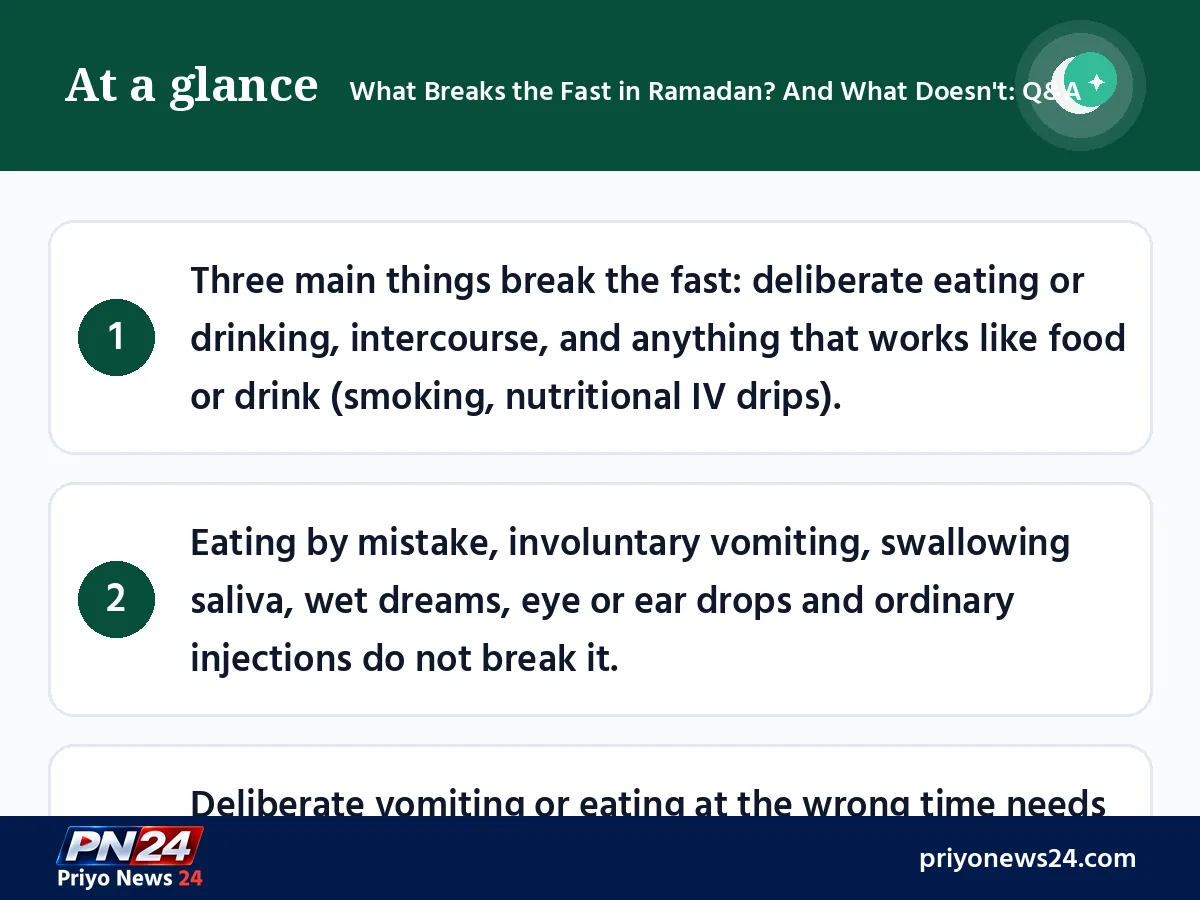
- Three main things break the fast: deliberate eating or drinking, intercourse, and anything that works like food or drink (smoking, nutritional IV drips).
- Eating by mistake, involuntary vomiting, swallowing saliva, wet dreams, eye or ear drops and ordinary injections do not break it.
- Deliberate vomiting or eating at the wrong time needs one make-up fast; deliberate intercourse in Ramadan needs make-up plus kaffarah.
Every Ramadan the same questions come up in almost every home. I drank water by mistake: is my fast gone? Do eye drops break the fast? Can I take an injection? Not knowing what breaks the fast leads some people to worry for no reason and others to spoil their fast without realising it. This guide explains, in plain language and with references to the Quran, authentic hadith and trusted scholars, which acts break the fast and which do not.
Keep one point in mind from the start: the rulings below follow the Hanafi school, which most people in Bangladesh follow, and the view of most scholars. For a complicated personal situation, ask a trusted scholar in your area.
What fasting is and when it became obligatory
The Arabic word for fasting is sawm, meaning "to hold back". In Islamic law it means making the intention and refraining from food, drink and marital relations from true dawn (subh sadiq) until sunset. Allah says: "O believers! Fasting is prescribed for you as it was prescribed for those before you, so that you may become mindful of Allah" (Surah Al-Baqarah 2:183).
Historians and scholars record that the Ramadan fast became obligatory in Sha'ban of the second year after the Hijra, in Madinah. According to Imam an-Nawawi, the Prophet (peace be upon him) fasted 9 Ramadans in his lifetime.
What breaks the fast: the three main things
Scholars group the things that break the fast into three broad types:
- Deliberate eating or drinking: knowingly eating or drinking while aware that you are fasting.
- Intercourse or any deliberate sexual act: doing this willingly during the day ruins the fast, and in Ramadan it requires kaffarah (expiation) as well as a make-up fast.
- Anything that works like food or drink: smoking, deliberately swallowing an object, drawing water or medicine through the nose into the throat, or a saline or glucose drip given for nourishment.
In addition, deliberately vomiting a mouthful breaks the fast. A hadith says that whoever is overcome by vomiting owes no make-up, but whoever makes himself vomit must make it up (Abu Dawud 2380, Tirmidhi 720).
Things that do not break the fast
People often worry about these acts, yet none of them harms the fast:
- Eating or drinking by mistake: stop when you remember; the fast is fine (Sahih al-Bukhari 1933).
- Involuntary vomiting, or vomit that goes back down by itself.
- Swallowing your own saliva: however much there is, swallowing the normal saliva in your mouth does not break the fast. Taking it out of the mouth and then putting it back and swallowing it does.
- A wet dream while asleep: it is involuntary, so the fast stays valid. Only a ritual bath (ghusl) becomes due, and it is better not to delay it.
- Dust, smoke or a fly entering the throat without your choice.
- Oil, pain-relief balm or lotion on the body or head. Vaseline or lip balm on the lips is also allowed, as long as none goes into the mouth.
- Wearing perfume or attar, or smelling flowers.
- Bathing, rinsing the mouth, putting water in the nose, provided you do not draw it into the throat.
- Using a miswak, even if the gums bleed slightly, as long as you do not swallow the blood.
- Burping after suhoor: belching in the morning after a heavy meal does not harm the fast, but do not deliberately swallow anything that comes up.
Medical treatment: what breaks the fast and what doesn't
Treatment raises the most questions. The table below follows the research summary of the Islamic Fiqh Academy and the explanations of scholars in Bangladesh:
| Treatment or act | Breaks the fast? | Note |
|---|---|---|
| Eye drops, kohl | No | Even if tasted in the throat |
| Ear drops | No | The ear is not a passage to the stomach |
| Medical injection, vaccine, insulin | No | Not a substitute for food |
| Blood test, tooth extraction, wound dressing | No | As long as no blood is swallowed |
| Nutritional saline or glucose drip | Yes | It works as nourishment |
| Tablets or syrup taken by mouth | Yes | Goes straight to the stomach |
| Cigarettes, hookah, e-cigarettes | Yes | Smoke deliberately taken in |
Scholars differ on inhalers. If you need one regularly, try to use it at suhoor and iftar, and if you need it during the day, follow your doctor's and a scholar's advice. If treatment makes fasting too hard, Islam allows you to skip the fast and make it up later; it does not ask you to put your life or health at risk.
Common mistakes about timing: suhoor and iftar
Is the fast valid without suhoor?
Yes. Suhoor is a blessed sunnah but not a condition of the fast. If you oversleep and miss it, still fast. In the Hanafi view it is best to make the intention for a Ramadan fast at night, but if you forgot and have not eaten since dawn, you may make the intention before midday.
Drinking water during the azan
The fast begins at true dawn, not at the azan. Mosques in different areas call the azan a few minutes apart, so rather than relying on the azan, the safe rule is to finish eating before the suhoor end time in your local calendar. If you knowingly ate after that time had passed, that fast must be made up.
Breaking the fast before sunset by mistake
Suppose someone breaks the fast on a cloudy day, or by a wrong clock, thinking the sun has set, and then sees the sun still up. Sahih al-Bukhari 1959 reports such an incident in the Prophet's time, and the narrator Hisham said the day had to be made up. In the Hanafi view the person should stop eating for the rest of the day and later make up one fast; no kaffarah is due.
Fasting during pregnancy and breastfeeding
A pregnant or breastfeeding mother who fears harm to herself or her baby may skip the fast. The Prophet (peace be upon him) said that Allah has relieved the traveller, the pregnant woman and the nursing woman of fasting (Tirmidhi 715). In the Hanafi view she makes up one fast for each day missed later, no more. If she will never be able to fast, then fidyah applies: feeding one poor person, or giving the equivalent in charity, for each day. Always talk to your doctor before making a health decision.
Qada versus kaffarah
| Situation | Make-up fast (qada) | Expiation (kaffarah) |
|---|---|---|
| Eating by mistake, involuntary vomiting | Not needed | Not needed |
| Deliberate vomiting | Needed | Not needed |
| Wrong timing at suhoor or iftar | Needed | Not needed |
| Skipping due to illness, travel or pregnancy | Needed | Not needed |
| Deliberate intercourse in Ramadan | Needed | Needed |
Kaffarah means fasting 60 days in a row, or, if that is not possible, feeding 60 poor people. In the Hanafi school, deliberately eating or drinking to break a Ramadan fast also requires kaffarah; other schools require only a make-up fast and repentance in that case.
Makruh acts: things that do not break the fast but spoil it
Makruh means disliked. These acts do not break the fast and need no make-up or kaffarah, but they reduce its reward and beauty. The standard Hanafi manuals (such as Nur al-Idah) list the following as disliked while fasting:
| Act | Ruling and reason |
|---|---|
| Chewing something without need (gum etc., not swallowed) | Disliked; if anything reaches the throat the fast may break |
| Tasting food and spitting it out | Disliked; a cook with a real need may taste on the tip of the tongue, as long as nothing goes down |
| Gathering saliva in the mouth and swallowing it on purpose | Disliked; normal swallowing of saliva is fine |
| Brushing with toothpaste or tooth powder | Disliked because of the strong taste; the miswak is fine, and paste is best used before suhoor ends |
| Gargling hard or drawing water deep into the nose during wudu or ghusl | Disliked; if water reaches the throat, the fast breaks |
| Deliberately delaying an obligatory bath for a long time | Disliked; the fast is valid if you eat suhoor in a state of janabah, but bathe soon |
| Complaining restlessly about hunger and thirst | Disliked |
| Lying, backbiting, abuse and quarrelling | Sinful at any time, and worse while fasting |
The hadith warns about this clearly. The Prophet (peace be upon him) said that whoever does not give up false speech and acting on it, Allah has no need of his giving up food and drink (Sahih al-Bukhari 1903). Another hadith says fasting is a shield: if someone picks a fight or insults a fasting person, he should say, "I am fasting" (Sahih al-Bukhari 1904).
Kissing or embracing one's wife is disliked for someone who fears losing control. It is also better to avoid anything that could force you to break the fast, such as giving so much blood that you become too weak to continue.
Common myths about fasting
- "Swallowing saliva weakens the fast": false. Normal saliva does no harm; there is no need to keep spitting all day.
- "You cannot brush your teeth": the miswak is a sunnah. Some scholars dislike toothpaste during the day, so using it after suhoor or after iftar is the safer choice.
- "Bathing reduces the fast": false. Bathing to stay cool is allowed; just do not draw water into the throat.
- "A blood test breaks the fast": false. Giving blood for a test does not break it.
Final word
There are only a few things that break the fast: deliberate eating or drinking, intercourse, and anything that works like food. Eating by mistake, involuntary acts, eye or ear drops and medical injections do not. Islam wants ease, not hardship, so learn the rules and fast without needless doubt. For a complicated case, ask a trusted scholar, and for any health question, talk to your doctor.
FAQ
Does eating by mistake break the fast?
No. If you forget you are fasting and eat or drink, your fast is still valid. Stop as soon as you remember and complete the day. The Prophet (peace be upon him) said that whoever eats or drinks forgetfully should complete the fast, because Allah fed him (Sahih al-Bukhari 1933).
Do eye drops break the fast?
According to most scholars, including the Hanafi school followed in Bangladesh, eye drops and kohl do not break the fast, even if you taste them in the throat, because the eye is not a passage for food or drink. Ear drops take the same ruling.
Can I take an injection or insulin while fasting?
Yes. Medical injections, vaccines and insulin are not a substitute for food, so they do not break the fast. A nutritional drip such as saline or glucose given for nourishment does break it; a sick person may make up that day later.
Is my fast valid if I miss suhoor?
Yes. Suhoor is a blessed sunnah, not a condition of the fast. If you oversleep and miss it, still make your intention and fast.
What if I drank water while the azan was being called?
The fast begins at true dawn (subh sadiq), not at the azan. Finish eating before the suhoor end time in your local calendar. If you knowingly ate or drank after that time, make up the fast later. If you are unsure about the timing, ask a trusted local scholar.
Does smoking break the fast?
Yes. Smoking means deliberately drawing smoke inside the body, so scholars agree it breaks the fast and the day must be made up. Ramadan is also a good chance to quit.
Sources
- What actions make fasting makrooh? — IslamQA (Muftisays)
- Sahih al-Bukhari 1933 — Sunnah.com
- Sahih al-Bukhari 1959 — Sunnah.com
- Jami at-Tirmidhi 715 — Sunnah.com
- Sunan Abi Dawud 2380 — Hadith Unlocked
- Surah Al-Baqarah 2:183 — Quran.com
- বিভিন্ন ঔষধ ও ডাক্তারি যন্ত্রপাতি ব্যবহারে রোযার উপর প্রভাব — IslamQA
- কখন থেকে রোজা ফরয হয়েছে? — IslamQA
- Does smoking break your fast? — IslamQA
- যে কারণে রোজা ভেঙে যায় — প্রথম আলো
- রোজা কি ভেঙে গেল? — প্রথম আলো
- যেসব কারণে রোজা ভাঙে না — জাগো নিউজ
Comments
No comments yet — be the first to comment.