

Benefits of Reading Surah al-Kahf on Friday: Whole Surah or First 10 Verses?

At a glance
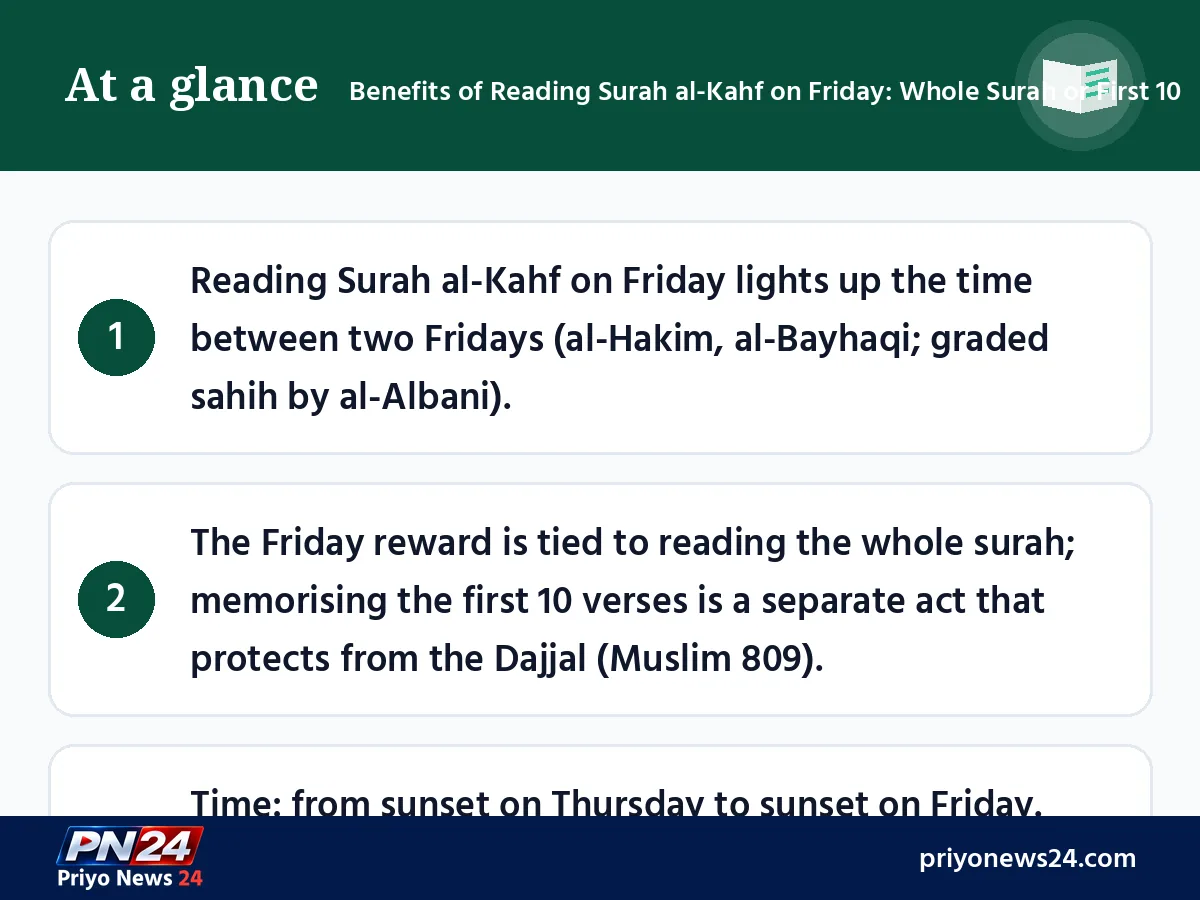
- Reading Surah al-Kahf on Friday lights up the time between two Fridays (al-Hakim, al-Bayhaqi; graded sahih by al-Albani).
- The Friday reward is tied to reading the whole surah; memorising the first 10 verses is a separate act that protects from the Dajjal (Muslim 809).
- Time: from sunset on Thursday to sunset on Friday. Reports about Surah ad-Dukhan or Al 'Imran on Friday are weak or fabricated.
The benefits of reading Surah al-Kahf on Friday are something many Muslims look up every week: when exactly to read it, whether the whole surah is needed or only a few verses, and which of the many "virtues" shared on social media are actually authentic. This guide answers those questions in one place, based on reliable hadith and scholars' explanations, so you can do this weekly act with confidence.
A note before we start: many weak and fabricated reports about Friday circulate online. That is why every hadith below comes with its source and grading. For the other sunnah acts of the day, see our guide to the virtues of Friday and its sunnah acts.
Surah al-Kahf at a glance
Surah al-Kahf is the 18th surah of the Qur'an. It has 110 verses and was revealed in Makkah. It begins in the middle of the 15th juz and ends in the 16th. "Kahf" means cave, and the surah takes its name from the story of the young men of the cave.
The surah contains four major stories, and scholars note that each one points to a major trial in life:
| Story | The trial it teaches about |
|---|---|
| The People of the Cave | The trial of faith: holding on to belief under pressure |
| The owner of the two gardens | The trial of wealth: gratitude instead of arrogance |
| Musa and al-Khidr | The trial of knowledge: humility and patience |
| Dhul-Qarnayn | The trial of power: ruling with justice |
The fitnah of the Dajjal is, in essence, all four trials together: he will try to mislead people through belief, wealth, knowledge and power. This is why Surah al-Kahf is linked with protection from him.
Benefits of reading Surah al-Kahf in authentic hadith
1. Light between the two Fridays
Abu Sa'id al-Khudri reported that whoever reads Surah al-Kahf on the day of Jumu'ah will have a light that shines for him between the two Fridays. It is recorded by al-Hakim (2/399) and al-Bayhaqi (3/249). Ibn Hajar called it hasan and the strongest report on the subject, and Shaykh al-Albani graded it sahih in Sahih al-Jami' (6470).
2. The same good news for the night of Jumu'ah
Another report from the same Companion mentions reading Surah al-Kahf on the night of Jumu'ah (after sunset on Thursday) and says it will give him a light stretching between him and the Ancient House, the Ka'bah. It is in Sunan al-Darimi (3407), and al-Albani graded it sahih in Sahih al-Jami' (6471). Taken together, scholars say the time for reading covers both the night and the day of Jumu'ah.
3. The first 10 verses: protection from the Dajjal
In Sahih Muslim (809), Abu al-Darda' reported that whoever memorises the first ten verses of Surah al-Kahf will be protected from the Dajjal. Another narration in Muslim mentions the last ten verses. In the long hadith of al-Nawwas ibn Sam'an (Muslim 2937), the Prophet (peace be upon him) told anyone who meets the Dajjal to recite the opening verses of Surah al-Kahf against him.
4. Tranquillity descending during recitation
In Sahih al-Bukhari (5011), al-Bara' ibn 'Azib narrated that a Companion was reciting Surah al-Kahf at night when something like a cloud covered him, and his horse tied nearby became restless. When he told the Prophet (peace be upon him) the next morning, he said it was the sakinah, the tranquillity that had come down because of the Qur'an.
Do you have to read the whole of Surah al-Kahf on Friday?
This is the most common question. In short:
- The Friday reward of light is tied in the hadith to "reading Surah al-Kahf", so the norm is to read the whole surah to earn it.
- Memorising the first 10 verses is a separate act whose reward is protection from the Dajjal. You can memorise and revise them on any day.
- One sitting is not required. Reading it in parts between Thursday sunset and Friday sunset is fine.
If you are short of time, here is a simple split: verses 1 to 50 on Thursday night before sleeping, verses 51 to 82 after Fajr on Friday, and the remaining 28 verses before Jumu'ah prayer or after Asr. At an average pace the whole surah takes about 20 to 30 minutes.
The right time to read Surah al-Kahf
| Time | Can you read it for the Friday reward? | Evidence |
|---|---|---|
| Thursday before sunset | No, the night of Jumu'ah has not begun | The Islamic day begins at sunset |
| Thursday after Maghrib (night of Jumu'ah) | Yes | al-Darimi 3407 |
| Friday from Fajr until before sunset | Yes | al-Hakim 2/399, al-Bayhaqi 3/249 |
| Friday after sunset | No, Jumu'ah has ended | — |
In Bangladesh, Thursday evening and Friday morning usually have a relaxed weekend feel, which makes them good times to build a family habit of recitation.
Reports that are weak or fabricated
Some "virtues" of Friday that spread on Facebook and YouTube have weak foundations. Know them before you act on them:
- Reading Surah ad-Dukhan on Friday: hadith scholars describe these reports as very weak or fabricated.
- Reading Surah Al 'Imran on Friday: al-Albani graded al-Tabarani's report fabricated (Da'if al-Jami' 5759).
- Special counts of al-Fatihah, al-Ikhlas, al-Falaq and al-Nas after Jumu'ah prayer: scholars also say these reports are weak. Reading these surahs is good in general, but attaching fixed numbers and special rewards to them is not supported.
The report from Ibn 'Umar about a light rising from the reader's feet to the sky is found in Ibn Mardawayh's tafsir, and al-Mundhiri said its chain had no problem. Still, the authentic report of Abu Sa'id al-Khudri is enough as the main evidence for this Friday practice.
Four lessons from Surah al-Kahf for everyday life
Read with its meaning, the surah guides you through the whole week:
- Holding on to faith under pressure: the young men of the cave stood firm against the pressure of their society. The courage to keep your prayer and honesty at work, on campus or among friends comes from here.
- No arrogance with wealth: the owner of the two gardens thought his wealth would last forever. Saying "ma sha' Allah, la quwwata illa billah" when your income grows is taught in this story (verse 39).
- Patience when you do not understand everything: the story of Musa and al-Khidr shows that much hardship hides wisdom we cannot see at the time.
- Power means responsibility: Dhul-Qarnayn used great power to help people and called his success a mercy from his Lord (verse 98).
- The habit of saying "in sha' Allah": verses 23-24 teach adding "in sha' Allah" whenever you speak of doing something in the future.
Simple ways to make it a habit
- Set a reminder: add a weekly phone reminder for Thursday at Maghrib.
- Read with the meaning: read the translation of one story each week; in four weeks you will understand all four.
- Memorise the first 10 verses: one verse a day gets you there in under two weeks.
- Involve your family: listen or read together with children; they enjoy the story of the young men of the cave.
- Focus on correct pronunciation: if you have not memorised it, read from the text; reading slowly and correctly is better than rushing.
Final word
The benefits of reading Surah al-Kahf are established in authentic reports: reading the whole surah on the night or day of Jumu'ah lights up the time between two Fridays, and memorising the first 10 verses carries the promise of protection from the Dajjal. The time runs from Thursday sunset to Friday sunset. Rather than chasing weak reports, keep up the authentic practice regularly, and ask a trusted scholar when in doubt. Allah knows best.
FAQ
When should Surah al-Kahf be read on Friday?
Any time from sunset on Thursday (the night of Jumu'ah) until sunset on Friday. Al-Darimi (3407) mentions the night of Jumu'ah and al-Hakim's report mentions the day; Shaykh al-Albani graded both sahih.
Do I have to read the whole surah, or are the first 10 verses enough?
The Friday reward of light is linked to reading Surah al-Kahf, so the norm is to read the whole surah. Memorising the first 10 verses is a different act with its own reward: Sahih Muslim (809) says it protects from the Dajjal.
Can I split the reading into several sittings?
Yes. Finishing it in parts between Thursday sunset and Friday sunset still counts. If you have not memorised it, read from a mushaf or a reliable Qur'an app.
Does listening to Surah al-Kahf bring the same reward?
The hadith speak of reading or reciting it. Listening to recitation is also a good deed, but reading it yourself is better if you can. Someone who cannot yet read can listen while learning.
Is reading Surah ad-Dukhan on Friday authentic?
No. Hadith scholars graded the reports about the virtue of Surah ad-Dukhan on Friday as very weak or fabricated. The report about reading Surah Al 'Imran on Friday was graded fabricated by al-Albani (Da'if al-Jami' 5759).
Can a menstruating woman read Surah al-Kahf?
Scholars differ. Many, including the Hanafi school, say a woman should not recite the Qur'an during menstruation, while others allow reciting from memory or without touching the mushaf. Ask a trusted scholar of your school.
Comments
No comments yet — be the first to comment.