

Chitoi Pitha Recipe: Soft Chitoi in a Clay Mould or Non-Stick Pan

At a glance
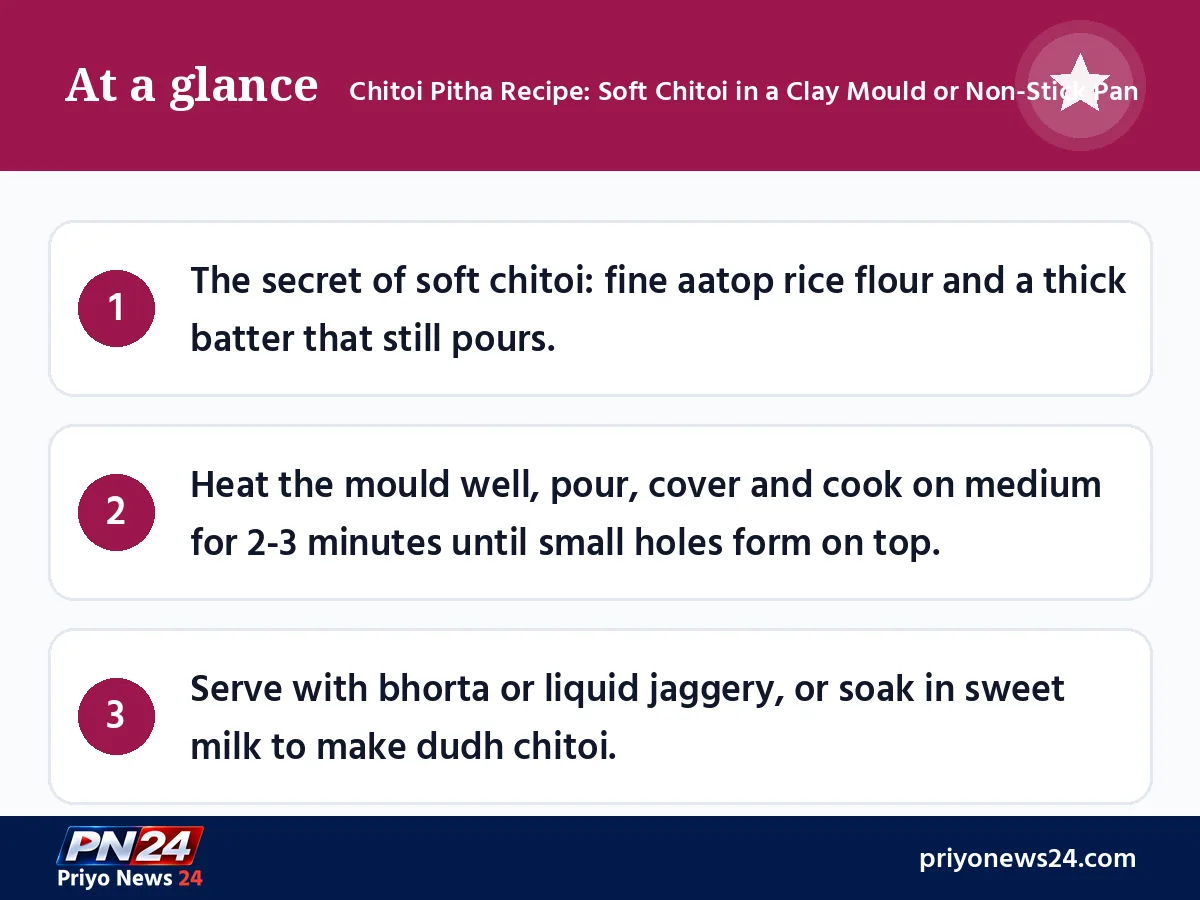
- The secret of soft chitoi: fine aatop rice flour and a thick batter that still pours.
- Heat the mould well, pour, cover and cook on medium for 2-3 minutes until small holes form on top.
- Serve with bhorta or liquid jaggery, or soak in sweet milk to make dudh chitoi.
On winter evenings in Bangladesh, a row of clay moulds on a street-corner stove, each with its lid, and bowls of bhorta beside them can only mean one thing: chitoi pitha. Made from nothing more than rice flour, water and salt, this steamed rice cake looks simple, yet at home it often sticks to the mould, stays raw inside or never gets its familiar lacy holes on top. This chitoi pitha recipe walks you through every step, for both a traditional clay mould and an ordinary non-stick pan, along with dudh chitoi and ideas for what to serve it with.
What you need for chitoi pitha
These quantities make about 12 to 15 medium pitha.
| Ingredient | Quantity | Purpose |
|---|---|---|
| Fine aatop (sun-dried) rice flour | 2 cups | Main body of the pitha |
| Water | About 2 to 2.5 cups (depends on the flour) | Batter |
| Salt | Half a teaspoon | Taste |
| Cooked rice (optional) | Half a cup | Blended into the batter for softness and puff |
| Oil | A little, for preparing the mould | Stops the first pitha sticking |
Equipment: a clay chitoi mould with a lid (or a small non-stick pan or iron karahi with a lid), a ladle or small bowl for measuring, and a spatula or knife.
A note on rice flour: many recipes suggest soaking fresh aatop rice and grinding it yourself, as this makes the softest pitha. Packaged flour from the shop also works, but because it is dry it may need a little more water. Blending a little cooked rice into the batter is another popular trick for fluffier, softer pitha.
Chitoi pitha recipe: step by step
Step 1: Make the batter
Put the rice flour and salt in a large bowl. Add water a little at a time, stirring so no lumps form. If you are using cooked rice, blend it with a splash of water and stir it in. The batter should be like thick yoghurt or thick dal: it should fall slowly from a spoon without setting solid. Cover and rest it for at least 20 to 30 minutes so the flour absorbs the water.
Step 2: Prepare and heat the mould
Put the clay mould on the stove and heat it well over medium-high heat. If the mould is new, rub a little oil on it the first time and wipe it off with a cloth or tissue. To test the heat, sprinkle a few drops of water: if they sizzle and vanish at once, the mould is ready.
Step 3: Pour and cover
Using a ladle or small bowl, pour the batter into the centre of the mould in one go. It will spread to fill the mould by itself, so do not stir it. Cover immediately. Many cooks sprinkle a little water around the edge of the lid so steam builds up inside.
Step 4: Timing and lifting
On medium heat the pitha is usually done in 2 to 3 minutes. Lift the lid and check: the top should no longer be wet and raw, it should look white with small holes, and the edges should start to come away from the mould. Gently lift it from the edge with a spatula or knife. Chitoi pitha is never flipped.
Step 5: Before the next pitha
Stir the batter each time before you pour, because rice flour settles at the bottom. If it thickens, add a spoonful or two of water.
Making a big batch for guests or family
A mould cooks one pitha at a time, so feeding many people takes a while. Two moulds on two burners, or two or three small moulds side by side on one stove, cut the time in half. Keep the finished pitha in a bowl covered with a clean cloth; the trapped steam keeps them soft instead of drying out.
Chitoi pitha in a non-stick pan
You can manage without a clay mould in a city kitchen. Use a small (about 6 to 7 inch) non-stick pan or a small, deep karahi with a lid that fits. Heat it on medium; no oil is needed. Pour and cover in the same way. In a non-stick pan the base browns less and the pitha lifts off easily; a clay mould gives a slightly crisp base and an earthy aroma.
Making rice flour at home and caring for a clay mould
To make your own rice flour, wash aatop rice the day before or in the morning and soak it for 4 to 6 hours. Drain it and leave it in a sieve until half-dry: the rice should feel damp but not drip. Grind it in small batches in a mill or a strong blender until fine, then sift it. Grind any coarse bits again, because coarse flour makes pitha crumbly and rough. This half-damp flour does not keep long, so use it at once or refrigerate it and finish it within a day or two.
When you bring a new clay mould home, do not start cooking straight away. Wash it, dry it thoroughly, then heat it empty on the stove for a while. Putting it suddenly on very high heat, or pouring cold water into a hot mould, can crack it. After use, clean it with hot water and a soft cloth instead of scrubbing with soap; this keeps its smooth surface intact so pitha stick less next time.
Common mistakes and fixes
| Problem | Likely cause | Fix |
|---|---|---|
| Pitha sticks to the mould | Mould not hot enough, or a new mould | Heat it more; wipe on a little oil the first time |
| No holes on top | Batter too thick, heat too low or no lid | Add a little water, raise the heat, cover right after pouring |
| Pitha is hard and rubbery | Batter too thin, or cooked too long | Thicken the batter; lift it as soon as holes appear |
| Raw inside | Heat too high, pitha too thick | Lower to medium; pour a little less batter |
| Pitha breaks | Batter not rested, or coarse flour | Rest the batter 30 minutes; use fine flour |
What to serve it with: from bhorta to dudh chitoi
Much of the joy of chitoi pitha is in what goes with it. Popular choices:
- Spicy bhorta: mustard bhorta, dried-fish (shutki) bhorta, coriander bhorta, green chilli and garlic bhorta.
- Date-palm jaggery: dipping it in liquid jhola gur or nolen gur is an old winter custom.
- Meat curry: in many regions chitoi is eaten with duck or beef curry.
- Dudh chitoi: boil milk until it thickens a little, then sweeten it with date-palm jaggery or sugar. If you use jaggery, let the milk cool slightly first to reduce the risk of curdling. Soak the chitoi in it for a few hours or overnight. Cardamom or cinnamon adds aroma.
- Egg chitoi: cracking an egg on top after pouring the batter and then covering it is also popular, with a little salt, chilli and chopped onion.
Storing and serving
Chitoi pitha is softest when eaten hot. Leftovers keep in an airtight box in the fridge for 1 to 2 days; warm them in a covered steamer or briefly in the mould before eating. Dudh chitoi kept in the fridge is also lovely cold. Our bhapa pitha recipe is also on the site, so you can make two kinds of winter pitha from the same rice flour in one day.
FAQ
Why does chitoi pitha stick to the mould?
Usually the mould is not hot enough or a new clay mould has not been prepared. Heat it, rub a little oil on it the first time and wipe it off, then make a test pitha. It is normal for the first one or two to stick; after that the mould settles.
Why don't holes form on top of my chitoi?
If the batter is too thick, the heat is too low or you do not cover it, steam does not build up and the lacy holes do not form. Keep the batter like thick yoghurt, heat the mould well and cover it as soon as you pour.
Can I make chitoi pitha without a clay mould?
Yes. A small non-stick pan, an iron karahi or a small cast-iron pan with a lid all work. A clay mould gives a little more aroma and a crisper base, but a non-stick pan still gives soft pitha.
How do you make dudh chitoi?
Boil milk until it thickens slightly and sweeten it with date-palm jaggery or sugar. If you use jaggery, let the milk cool a little first, because adding jaggery to boiling milk can make it curdle. Soak the chitoi in the milk for a few hours or overnight so it turns soft and sweet.
How long should the batter rest?
Rest the batter, covered, for at least 20 to 30 minutes so the flour absorbs the water and the pitha turns out soft. Some people make the batter at night for the morning; in that case keep it in the fridge and check its thickness before cooking.
Comments
No comments yet — be the first to comment.