

Breastfeeding the Right Way: From the First Hour to 2 Years, and How to Tell Your Baby Is Getting Enough

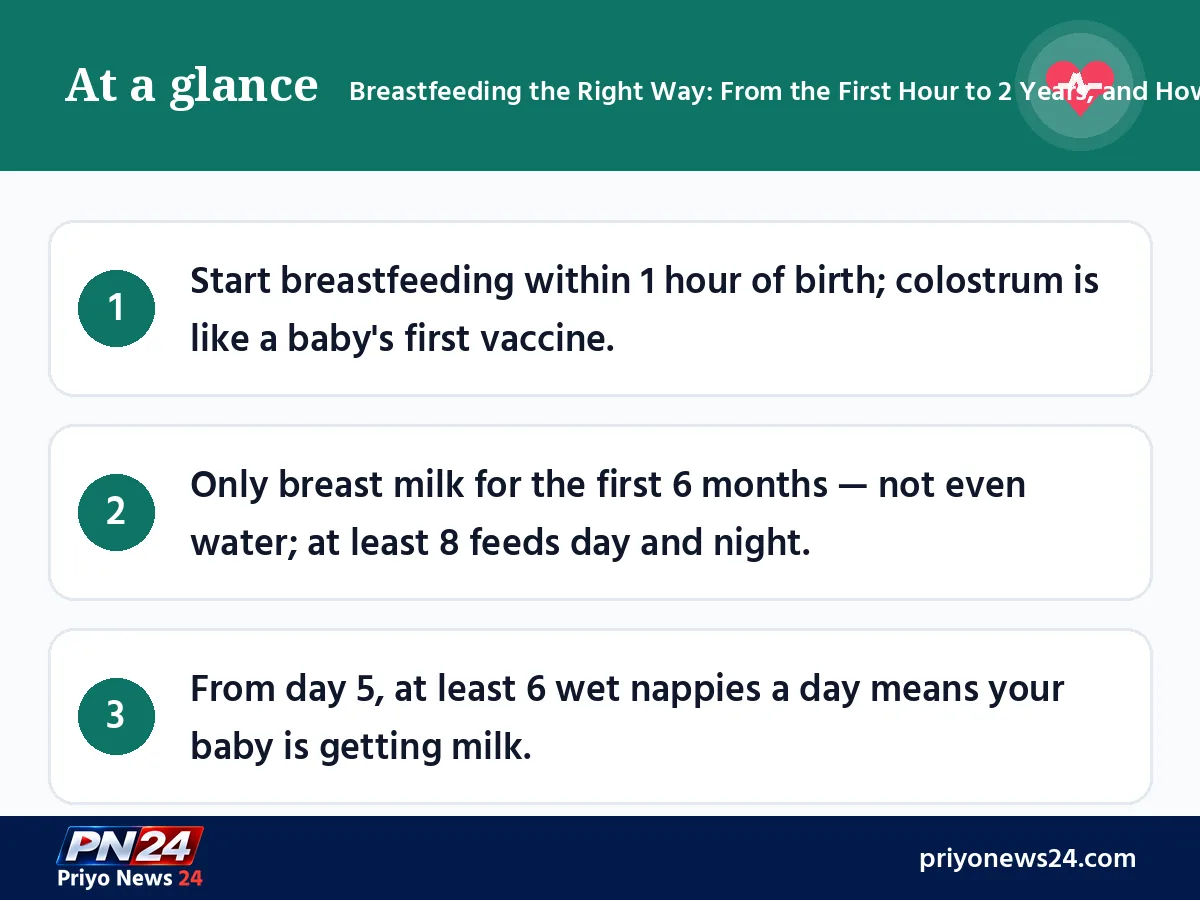
At a glance
- Start breastfeeding within 1 hour of birth; colostrum is like a baby's first vaccine.
- Only breast milk for the first 6 months — not even water; at least 8 feeds day and night.
- From day 5, at least 6 wet nappies a day means your baby is getting milk.
For a newborn, mother's milk is not only food but also the first protection. Still, new mothers often feel unsure: how often should I feed, is my baby really getting enough, should I give water in hot weather, what happens when I go back to work? This guide sets out how to breastfeed the right way, step by step, combining advice from the World Health Organization (WHO), UNICEF and the UK's National Health Service (NHS), with the realities of mothers in Bangladesh in mind.
Why breast milk: WHO's three key recommendations
WHO and UNICEF give three clear recommendations on breastfeeding:
- Start within 1 hour of birth. If the baby is placed skin-to-skin on the mother's chest right after birth, the baby will find the breast by itself.
- Only breast milk for the first 6 months. No water, honey, sugar water, cow's milk or formula during this time.
- From 6 months, add complementary food and continue breastfeeding to 2 years of age or beyond.
Breast milk contains all the nutrients and water a baby needs for the first 6 months. Its antibodies protect against illnesses such as diarrhoea and pneumonia. WHO notes that breastfed children perform better on intelligence tests later in life and are less likely to become overweight or develop diabetes, while mothers who breastfeed have a lower risk of breast and ovarian cancer.
In August 2026 WHO Europe reported that in its region 3 in 4 newborns are breastfed within the first hour, yet only 43 percent are exclusively breastfed at 6 months. Starting is easy; keeping going is the challenge — and that is where good information helps most.
Colostrum: don't throw it away
The thick, yellowish milk that comes in the first few days after birth is called colostrum. It is small in amount but rich in antibodies; UNICEF compares it to a baby's first vaccine. In many families it is still common to discard this milk, or to put honey, sugar water or something else in the newborn's mouth. Don't; let colostrum be the baby's first food.
How to breastfeed: step by step
1. Sit or lie in a comfortable position
Sit with a pillow behind your back, or feed lying on your side. The baby's head, shoulders and body should be in a straight line, with the baby's tummy facing yours. Bring the baby to the breast rather than leaning the breast towards the baby.
2. A good latch
A good latch is the key to successful feeding. According to the NHS and UNICEF, signs of a good latch are:
- The baby's mouth is wide open and the chin touches the breast.
- The baby takes in not just the nipple but a large part of the dark area around it (the areola); more of the areola shows above the top lip than below the bottom lip.
- The cheeks look round and full, not sucked in.
- After a few quick sucks at the start, the baby sucks in slow, long draws and you can hear swallowing.
- It doesn't hurt. A little discomfort at first is possible, but ongoing pain means the latch is not right.
3. Feed on hunger cues
Babies show hunger before they cry: opening the mouth, turning the head from side to side, putting hands to the mouth, licking the lips. Crying is a late hunger cue. In the first few weeks a newborn usually feeds at least 8 times or more in 24 hours, including at night. Don't watch the clock; feed whenever the baby wants.
4. Finish one breast, then offer the other
Let the baby feed from one breast until they come off by themselves, then offer the other. Milk towards the end of a feed is richer in fat, which helps the baby gain weight. Next time, start with the breast you finished on.
5. Burp the baby
After the feed, hold the baby upright on your shoulder and gently pat the back to release swallowed air.
How to tell your baby is getting enough milk
This is mothers' biggest worry. According to the NHS, look for these signs:
| Baby's age | Wet nappies (per 24 hours) | Poo |
|---|---|---|
| Day 1-2 | 1-2 | Dark, sticky (meconium) |
| Day 3-4 | 3 or more, getting heavier | Getting lighter in colour |
| From day 5 | At least 6 heavy wet nappies | At least 2 soft yellow poos a day |
Also, the baby seems content after feeds and comes off the breast on their own, is alert when awake, and gains weight steadily. Losing some weight in the first few days is normal; babies should regain their birth weight within about 2 weeks.
When to see a doctor: if the baby passes less urine or it is dark yellow, the baby is very sleepy and won't feed, the skin or eyes turn yellow, or the baby is not gaining weight, see a paediatrician without delay.
Common problems and fixes
- "I don't have enough milk": Breast milk is made on demand — the more the baby sucks, the more milk comes. Feeding often is the main way to increase supply. Adding formula means the baby sucks less, which can reduce supply further.
- Sore or cracked nipples: Usually caused by a poor latch. Gently open the corner of the baby's mouth with a finger to take them off and try again.
- Heavy, hard breasts: Feed more often, or express a little milk by hand to soften the breast. A red, hot, painful area with fever may be an infection (mastitis) — see a doctor.
- Mother's diet: The mother needs extra nutritious food and enough water. Even when the mother is ill, breastfeeding can usually continue, but tell the doctor you are breastfeeding before taking any medicine.
Working mothers: storing expressed milk
You can keep giving breast milk after returning to work. Express milk by hand or with a pump into a clean, covered container and write the date and time on it. According to the US Centers for Disease Control and Prevention (CDC):
- At room temperature (25°C or cooler): up to 4 hours. In Bangladesh's heat, if the room is warmer, put the milk in the fridge without delay.
- In the back of the fridge (about 4°C): up to 4 days. Keep it at the back, not in the door.
- In the freezer: best used within 6 months; up to 12 months at most.
Thaw frozen milk in the fridge or by standing the container in warm water; don't heat it in a microwave, which heats unevenly and can burn the baby's mouth. Never refreeze thawed milk. The baby can be fed with a cup or spoon, which also lowers the germ risk of bottles.
Final word
Breastfeeding is natural, but it is not always easy — mother and baby both need a few days to learn. Starting in the first hour, giving only breast milk for 6 months, feeding on demand day and night, and watching wet nappies and weight will prevent most problems. When family members help with housework and let the mother rest, breastfeeding becomes much easier.
Information as of November 2026, based on guidance published by WHO, UNICEF, the NHS and the CDC. For any health problem of the mother or baby, consult a doctor.
FAQ
How many times a day should a newborn breastfeed?
In the first few weeks a newborn usually feeds at least 8 times or more in 24 hours. Don't feed by the clock; feed whenever the baby shows hunger cues, day and night. WHO calls this feeding on demand.
Should a baby be given water before 6 months?
No. According to WHO and UNICEF, breast milk alone is enough for the first 6 months; even in hot weather there is no need for extra water, honey, sugar water or anything else. Most of breast milk is water.
How do I know my baby is getting enough milk?
According to the NHS, from day 5 after birth at least 6 wet nappies and at least 2 soft yellow poos a day, a baby who seems content after feeds, and steady weight gain are good signs. Babies should be back to their birth weight within about 2 weeks.
How long can expressed breast milk be kept?
Under US CDC guidance, up to 4 hours in a room at 25°C or cooler, up to 4 days in the back of the fridge, and ideally within 6 months in the freezer. In Bangladesh's heat, if the room is warmer than 25°C, put the milk in the fridge as soon as possible.
What should I do if breastfeeding hurts?
Pain usually means the baby is not latched on well. Gently break the suction with a finger and try again so the baby takes a large part of the dark area around the nipple, not just the nipple. If part of the breast becomes red, hard and hot, or you get a fever, see a doctor without delay.
Sources
- WHO — Breastfeeding: questions and answers
- WHO EMRO — Exclusively breastfeed for 6 months
- UNICEF — Why breastfeeding is critical for babies
- NHS — Breastfeeding: is my baby getting enough milk?
- Cambridge University Hospitals NHS — Signs your baby is getting enough milk
- CDC — Proper storage and preparation of breast milk (archived)
- WHO Europe — Three in 4 newborns are breastfed within the first hour, yet only 43% are exclusively breastfed by 6 months (2026)
Comments
No comments yet — be the first to comment.