

Complementary Feeding From 6 Months to 2 Years: What, How Much and How Often

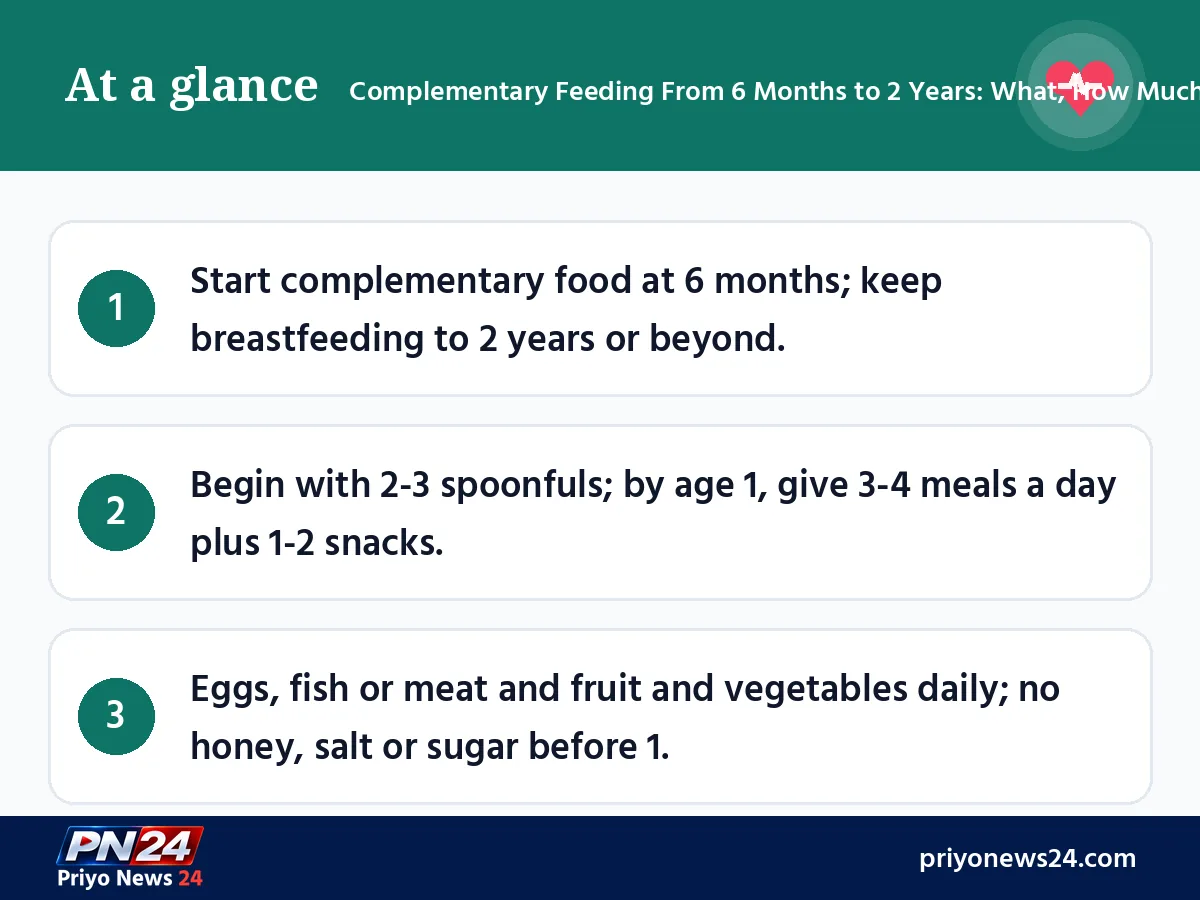
At a glance
- Start complementary food at 6 months; keep breastfeeding to 2 years or beyond.
- Begin with 2-3 spoonfuls; by age 1, give 3-4 meals a day plus 1-2 snacks.
- Eggs, fish or meat and fruit and vegetables daily; no honey, salt or sugar before 1.
When a baby completes 6 months, a new chapter in their eating life begins. Until now breast milk alone was enough, but from this point milk can no longer meet a growing body's full need for energy, iron, zinc and vitamins. That is when complementary feeding — giving family foods alongside breast milk — has to start. Which food to begin with, how much, how many times a day, what to avoid before the first birthday: many parents are unsure. This guide brings together the World Health Organization's (WHO) 2023 guideline and UNICEF's advice.
When to start: at 6 completed months
WHO says babies should get only breast milk for the first 6 months, and complementary foods that are safe and nutritious should start once they complete 6 months (about 180 days). Breastfeeding should continue alongside for 2 years or longer.
Starting too early means the baby drinks less breast milk and faces a higher risk of infections such as diarrhoea. Starting too late raises the risk of iron deficiency, low weight and faltering growth. Signs that a baby is ready:
- can sit up with support and hold the head steady
- shows interest in food and opens the mouth
- swallows food instead of pushing it out with the tongue
How much and how often, by age
Based on WHO and UNICEF advice, here is a simple chart for a breastfed baby (using an ordinary 250 ml cup or bowl):
| Age | Meals a day | Amount each time | Texture |
|---|---|---|---|
| 6-8 months | 2-3 meals, plus 1-2 snacks if needed | start with 2-3 spoonfuls, slowly increase to half a cup | well mashed, thick and soft |
| 9-11 months | 3-4 meals + 1-2 snacks | half a cup | finely chopped or lumpy, soft finger foods |
| 12-23 months | 3-4 meals + 1-2 snacks | three-quarters to a full cup | family food, cut or mashed as needed |
A baby who is not breastfed needs to eat more often. By WHO's standard, such a child aged 6-23 months should get at least 4 milk feeds or meals a day, at least one of them a soft or solid food.
Thickness matters. Thin porridge or watery semolina fills the stomach but carries little nutrition. Food that stays on a tilted spoon without running off has the right thickness.
What to give: what every day's plate needs
The heart of WHO's 2023 guideline is variety. Foods are grouped into 8 groups: breast milk; grains, roots and tubers such as rice, flour and potato; pulses, nuts and seeds; milk and dairy; meat, fish and liver; eggs; vitamin A-rich fruit and vegetables (pumpkin, carrot, ripe papaya, mango, dark green leafy vegetables); and other fruit and vegetables. Try to give foods from at least 5 groups every day.
- Animal foods every day: eggs, fish, chicken or beef. They are rich in iron, zinc and protein, which a baby needs most at this age.
- Fruit and vegetables every day: banana, papaya, mango, pumpkin, carrot, greens.
- Pulses, nuts and seeds often: especially when fish and meat are scarce. Give nuts ground or as a paste, never whole.
- A little oil: a spoonful of oil in khichuri adds energy and softens the food.
A simple, nutritious khichuri
- Wash a handful of rice and half a handful of red lentils or mung beans.
- Cut pumpkin, carrot or potato into small pieces and chop some greens.
- Boil everything together with enough water, and add a spoonful of oil at the end.
- Where possible, mix in boiled egg, deboned fish or minced chicken.
- For a 6-8-month-old, mash it thick and smooth; leave it lumpier as the baby grows. No salt before age 1.
A sample day for a 9-11-month-old
- Morning: breastfeed, then half a cup of thick semolina or rice porridge with a mashed, well-boiled egg.
- Mid-morning snack: mashed ripe banana or papaya.
- Lunch: half a cup of vegetable-and-lentil khichuri with deboned fish.
- Afternoon snack: soft boiled pumpkin or potato pieces the baby can hold and eat.
- Night: soft rice with lentils and minced chicken or a greens curry.
- All day: breastfeed on demand.
This is only an example; adjust it to the season and your family's food, but try to include an animal food and fruit or vegetables every day.
Foods to avoid before the first birthday
Based on NHS and WHO guidance:
- Honey: risk of infant botulism, a serious illness — none at all before 12 months.
- Salt: a baby's kidneys can't cope with extra salt; don't add salt to their food.
- Sugar and sweet drinks: WHO advises avoiding sugary juices, soft drinks, sweet biscuits, crisps and packaged snacks.
- Whole nuts, whole grapes or hard round foods: choking risk; no whole nuts under 5, and cut grapes lengthways.
- Raw or undercooked eggs, fish and meat: cook them thoroughly.
- Tea and coffee: they reduce iron absorption.
How to feed: responsive feeding
WHO calls it "responsive feeding" — feeding in response to the baby's signs of hunger and fullness.
- Sit the baby upright on your lap or in a high chair and feed from the baby's own bowl, so you can see how much was eaten.
- Feed slowly and patiently, talking to the baby; never force or frighten them.
- Try not to build a habit of feeding in front of a phone or TV.
- Introduce one new food at a time; if the baby refuses it, try again a few days later.
- Use a cup and spoon instead of a feeding bottle; bottles are hard to keep clean and carry more germs.
Don't forget hygiene
Wash your hands with soap before preparing food and feeding, and wash the baby's hands too. Keep utensils clean, cover cooked food, and serve freshly cooked food instead of food that has sat out for a long time. At this age diarrhoea is one of the biggest enemies of a baby's nutrition.
Feeding a sick baby
During fever or diarrhoea a baby's appetite drops. Breastfeed more often, give more fluids, and offer small amounts of soft foods the baby likes, again and again. After recovery, feed a little more than usual for a few days so lost weight comes back. If the baby can't eat at all, vomits repeatedly or becomes listless, go to a hospital without delay.
Final word
A child's first 2 years lay the foundation of lifelong health and learning. Expensive packaged foods aren't needed — home-cooked khichuri, eggs, fish, lentils, vegetables and seasonal fruit are enough. What matters is starting at the right time, giving the right amount for the age, and patience. Track the baby's weight and height regularly, and see a paediatrician if growth stalls or signs of food allergy appear.
Information reflects WHO, UNICEF and NHS guidance as of November 2026. Talk to a doctor about any specific health concern for your child.
FAQ
At what age should I start solid food?
WHO advises starting complementary food once the baby completes 6 months (about 180 days). Until then breast milk alone is enough — not even extra water is needed. After 6 months milk alone no longer covers the baby's needs for energy, iron and other nutrients.
How many times a day should a 6-month-old eat?
Give a breastfed baby of 6-8 months at least 2 meals a day (usually 2-3), and at least 3 meals (3-4) at 9-23 months, plus 1-2 nutritious snacks if needed. A baby who is not breastfed needs to eat more often.
Can I give my baby honey?
Not before 12 months. The NHS explains that honey can contain bacteria that produce toxins in a baby's gut and cause infant botulism, a serious illness. Avoid the custom of putting honey or anything sweet in a newborn's mouth too.
What should go into a baby's khichuri?
Rice, red lentils or mung beans, vegetables such as pumpkin, carrot and greens, a little oil, and where possible egg, fish or chicken. Mash it well at first and leave it lumpier as the baby grows. Don't add salt before age 1.
What if my baby refuses to eat?
Don't force-feed. Try again patiently in a calm setting with phones and TV off; babies often accept a new food only after it has been offered several times. If the baby is not gaining weight or seems unwell, see a paediatrician.
Sources
- WHO — Guideline for complementary feeding of infants and young children 6-23 months of age (2023)
- WHO — Infant and young child feeding fact sheet
- WHO — Minimum meal frequency, 6-23 months (indicator)
- PAHO/WHO — Guiding principles for complementary feeding of the breastfed child
- UNICEF — Improving young children's diets during the complementary feeding period (2020)
- NHS — Foods to avoid giving babies and young children
Comments
No comments yet — be the first to comment.