

How Small Businesses Can Use AI: 8 Practical Jobs and Key Cautions for Online Sellers

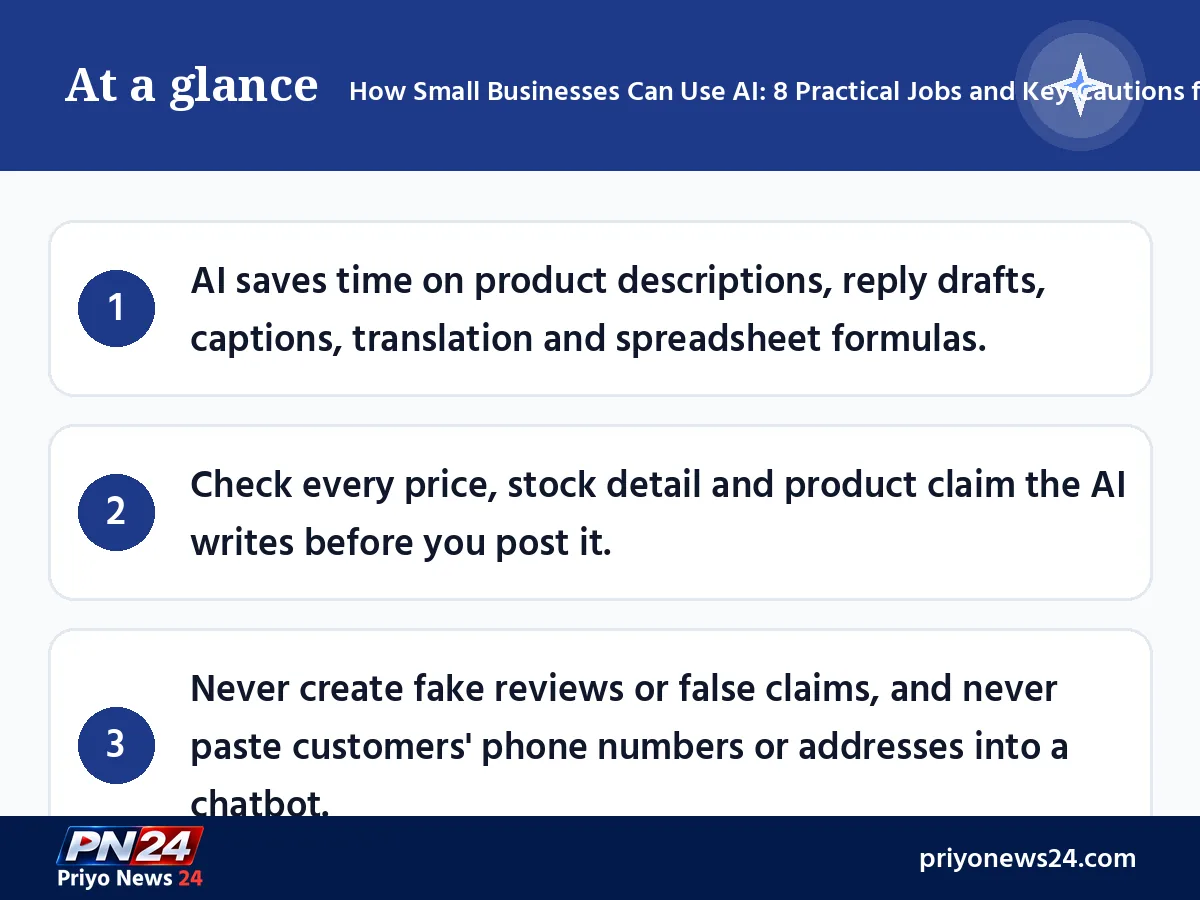
At a glance
- AI saves time on product descriptions, reply drafts, captions, translation and spreadsheet formulas.
- Check every price, stock detail and product claim the AI writes before you post it.
- Never create fake reviews or false claims, and never paste customers' phone numbers or addresses into a chatbot.
Selling clothes from a Facebook page, taking orders for home-cooked food, running a small grocery or an online gadget shop: hundreds of thousands of Bangladeshi entrepreneurs buy stock, take photos, write posts, answer customers and keep accounts on their own. Artificial intelligence can now help with much of that work. Knowing how small businesses can use AI properly can save hours every day, while using it badly puts customer trust and legal standing at risk.
This guide covers 8 jobs that everyday AI chatbots such as ChatGPT and Gemini can do, with example prompts, plus the rules and cautions that apply as of November 2026.
Where AI helps a small business most
| Job | What AI can do | What you must still do |
|---|---|---|
| Product descriptions | Write clear, appealing copy | Give the correct size, material and price, and check it |
| Customer messages | Draft answers to common questions | Handle complaints and money matters yourself |
| Social posts | Captions, hashtags, post plans | Keep the brand voice and the truth |
| Accounts | Spreadsheet formulas, cost breakdowns | Enter the real figures and reconcile them |
| Planning | Ideas, checklists, offer drafts | Decide based on your market and costs |
The key point: AI is a fast assistant, not the owner. Decisions, accuracy and the relationship with customers remain your responsibility.
8 practical ways small businesses can use AI
1. Writing product descriptions
You provide the facts and the AI tidies up the language. An example prompt:
"I sell women's cotton three-piece outfits on Facebook. Product: hand-embroidered cotton three-piece, sizes M and L, blue and maroon, colour does not fade after washing. Write a description in simple Bangla in under 80 words and end with the key details in 3 bullet points."
AI can "invent" details you never gave it, such as "100% original" or "imported". Before posting, delete every claim that is not true.
2. Drafting replies to customers
"What's the price?", "What is the delivery charge outside Dhaka?", "Can I return it?" The same questions arrive every day. Use AI to draft polite, clear answers and store them in your Facebook page's saved replies. Just make sure each answer states your real policy on charges, timing and returns.
3. Captions and post plans for Facebook and Instagram
Ask for "10 post ideas for a winter clothing page for the next 2 weeks, each with a 2-line caption" and you will get a list in seconds. Pick the ones that fit your business and reword them a little, so your posts do not all sound like the same "AI voice".
4. Translating between Bangla and English
Customers abroad, foreign suppliers and marketplaces need English descriptions. Let AI translate, then check that product names, sizes and numbers are still correct.
5. Accounts and spreadsheets
Ask, "In Google Sheets, column A has product names, B the purchase price and C the selling price; give me a formula for profit percentage in column D", and the AI will write the formula. You can also build a template that splits monthly costs into rent, delivery, advertising and packaging. Ask only for the structure, without pasting real figures, and your data stays private.
6. Writing offers, notices and policies
AI is useful for drafting a return policy, delivery terms, an Eid offer announcement or a shop-closure notice. For terms with legal weight, such as refund rules, read every line yourself.
7. Ideas for new products and markets
A prompt such as "Give me 10 ideas for products office-going women in Dhaka might need in winter" is a good way to start thinking. Remember that AI does not know your real sales or today's market prices; test ideas by talking to your customers and trying them on a small scale.
8. Learning and problem-solving
The basics of Facebook ads, what to look for in a courier contract, or a checklist for hiring your first employee: AI can explain such topics step by step like a patient teacher. Always confirm important rules or fees from official sources.
If you want to move your business from a Facebook page to your own website, look at platforms that bring orders, courier, payments and an AI assistant together. For example, the Bangladeshi e-commerce service eCommerce Autopilot offers Autopilot AI, built to help with product copy, customer replies and day-to-day business work.
What never to do: law, trust and data protection
Do not create fake reviews. Posting reviews or "customer comments" that customers never wrote, generated by AI, is deception. In August 2024 the US Federal Trade Commission finalised a rule banning fake reviews and testimonials, including AI-generated ones. In Bangladesh, deceiving buyers through false advertising is a punishable offence under the Consumer Rights Protection Act, 2009.
Do not alter product photos. AI can tidy up a background, but changing a product's colour, size or quality misleads customers and leads to returns and negative comments. Meta says it shows an "AI info" label on realistic AI-generated images, video or audio on Facebook and Instagram, and in some cases users must disclose it themselves.
Do not paste customer data into chatbots. Never paste customers' names, phone numbers, addresses or order lists into a general chatbot. Google's Gemini privacy hub says human reviewers may read some conversations, and OpenAI's Data Controls page has a setting to stop chats being used for training. Write "a customer" or "an order" instead of the real details.
Do not trust AI facts blindly. AI can give outdated or wrong information on VAT, trade licence fees, courier charges or the law. Check government websites or the organisation concerned.
Where AI policy stands in Bangladesh
The government has published a draft "Bangladesh National AI Policy 2026-2030" (Draft v2, February 2026), available on aipolicy.gov.bd. Once the policy is finalised, new guidance on business use of AI may follow, so entrepreneurs should keep an eye on it. For now, it is safest to assume that existing laws on consumer rights, advertising and digital transactions also apply to AI-generated content.
A simple plan to get started
- Week 1: Use AI only for product descriptions and captions.
- Week 2: Draft answers to your 10 most frequent questions and store them as saved replies.
- Week 3: Build a spreadsheet template for costs and profit.
- Week 4: Look at how much time you saved and how customers responded, then decide where else to use AI.
Final word
How small businesses can use AI comes down to a simple split: give AI the repetitive writing and drafting, but keep accuracy, customer privacy and honest advertising in your own hands. Used this way, AI saves you time while your customers' trust stays intact.
Sources: The US Federal Trade Commission's rule on fake reviews and MarTech's report, Meta's AI content labelling policy, Bangladesh's Consumer Rights Protection Act, 2009, the draft National AI Policy, Google's Gemini Apps Privacy Hub and OpenAI's Data Controls page.
FAQ
Does using AI in a small business cost money?
The free versions of chatbots such as ChatGPT and Gemini can handle many jobs, including product descriptions, captions and reply drafts. Paid plans exist for heavier use or extra features; prices change over time, so check the official site before buying.
Can AI write product descriptions in Bangla?
Yes, the major chatbots can write in Bangla. Still, read the result yourself to fix spelling, wording and facts. You must supply the size, material, price and warranty details, because the AI does not know them.
Is it acceptable to have AI write reviews?
No. Creating reviews that customers did not write is deception. The US Federal Trade Commission finalised a rule in 2024 banning fake reviews, including AI-generated ones, and in Bangladesh deceiving buyers through false advertising is punishable under the Consumer Rights Protection Act.
Can I advertise products with AI-generated images?
You can use AI for banners or backgrounds, but you should not change how the product really looks, its colour or size. What a customer sees when ordering should be what arrives. Meta shows an 'AI info' label on realistic AI content.
Can I leave customer messages entirely to AI?
Better not at first. Use AI to draft and save answers to common questions such as price, delivery charges and return policy, but answer complaints, refunds and special orders yourself.
Sources
- Federal Trade Commission — Final rule banning fake reviews and testimonials (August 2024)
- MarTech — U.S. FTC ban on fake, AI-generated reviews takes effect
- Meta — Our approach to labeling AI-generated content and manipulated media
- Bangladesh Laws (Ministry of Law) — Consumer Rights Protection Act, 2009
- Bangladesh National AI Policy 2026-2030 Draft v2 (aipolicy.gov.bd)
- Google — Gemini Apps Privacy Hub
- OpenAI Help Center — Data Controls FAQ
Comments
No comments yet — be the first to comment.