

Newborn Jaundice: Signs, Home Care, Is Sunlight Safe, and When to Rush to Hospital

At a glance
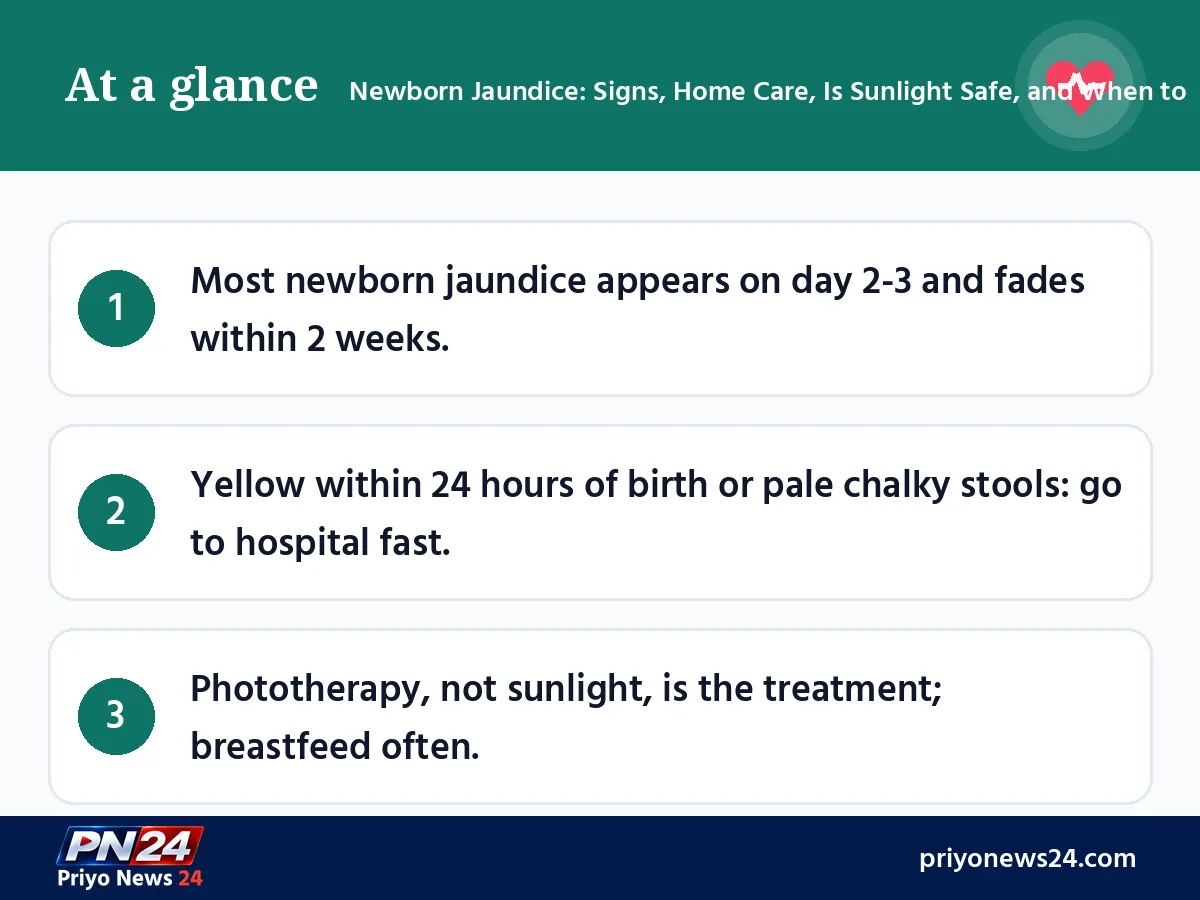
- Most newborn jaundice appears on day 2-3 and fades within 2 weeks.
- Yellow within 24 hours of birth or pale chalky stools: go to hospital fast.
- Phototherapy, not sunlight, is the treatment; breastfeed often.
Two or three days after birth, many mothers notice that their baby's face, the whites of the eyes or the chest look slightly yellow. This is newborn jaundice. According to the NHS, about 6 in 10 newborns and about 8 in 10 premature babies develop jaundice. In most cases it is harmless and clears up on its own. But some jaundice, if not treated in time, can damage a baby's brain. That is why every parent should know which jaundice is normal and which is a warning sign.
This guide explains why baby jaundice happens, how to check for it at home, which signs mean you should go to hospital the same day, what phototherapy is, and what medical guidance says about the common habit of putting babies in the sun.
Why newborn jaundice happens
When old red blood cells break down, the body produces a yellow substance called bilirubin. The liver processes it and the body removes it through the stool. Newborns have more red blood cells, and these break down quickly, while the liver is not fully up to speed in the first few days. Bilirubin builds up in the blood and makes the skin and eyes look yellow. This is called normal or "physiological" jaundice.
Sometimes there is another cause: a blood group mismatch between mother and baby (especially when the mother is group O or Rh negative), infection, G6PD deficiency, thyroid problems, or liver and bile duct disease. In these cases jaundice tends to start early, rise high or last a long time.
Babies at higher risk:
- Babies born before 37 weeks
- Babies whose older brother or sister needed phototherapy
- Babies with bruising on the head or body from birth
- Babies who are not latching or feeding well
- Babies whose blood group does not match the mother's
How to check for baby jaundice at home, step by step
Jaundice usually shows first on the face, then spreads to the chest and tummy, and to the arms and legs as the level rises. Check once a day like this:
- Use daylight. Tube lights and yellow bulbs hide the true colour. Look at your baby near a window in natural light.
- Press the skin gently. Press lightly on the forehead or the tip of the nose and let go. If the pressed spot looks yellow instead of pale, there is jaundice.
- Look at the eyes and gums. On darker skin, colour is hard to judge. Check the whites of the eyes, the gums, the palms and the soles of the feet.
- Watch the urine and stool. A newborn's urine should be almost colourless and the stool yellow or greenish. Dark yellow urine or pale, chalky white stool is a warning sign.
- Notice feeding and sleep. If your baby is very sleepy, hard to wake or will not suck, do not wait.
Remember: you cannot judge the bilirubin level reliably by eye. When in doubt, getting it measured is the safe choice.
When to go to hospital without delay
If you see any one of these signs, take your baby to a paediatrician or the nearest hospital the same day:
| Sign | Why it matters |
|---|---|
| Yellow within the first 24 hours after birth | May point to a blood group mismatch or infection |
| Yellow spreading to arms, legs, palms or soles | Suggests a high bilirubin level |
| Baby very sleepy and not wanting to feed | Warning sign of high bilirubin |
| Pale or chalky white stool, dark yellow urine | Can be a sign of liver or bile duct disease |
| Fever, high-pitched cry, arching the body backwards | Emergency — go to hospital immediately |
| Jaundice beyond 14 days in a term baby, or 21 days in a premature baby | Prolonged jaundice needs tests to find the cause |
Very high bilirubin that lasts long enough can enter the brain and cause permanent damage called "kernicterus", which can lead to hearing loss or cerebral palsy. With timely treatment, it is almost always preventable.
Treating newborn jaundice: what is phototherapy
Most normal jaundice needs no treatment; it fades within days if the baby feeds well. When bilirubin rises above a set limit, the doctor starts phototherapy.
- Phototherapy: the baby lies undressed (in a nappy only) under a special blue light, with the eyes covered. The light changes bilirubin in the skin into a form the body can pass more easily in urine and stool. It is painless and usually lasts from one to a few days. Mothers can keep breastfeeding during treatment.
- Blood tests: bilirubin is checked regularly during treatment to see if the light is working.
- Exchange transfusion: for very severe jaundice, or when phototherapy does not work, the baby's blood is gradually replaced. This is rare and done in a neonatal intensive care unit (NICU).
The level at which treatment is needed depends on the baby's age in hours, the week of birth and risk factors. So never compare your baby's report with another baby's numbers to make a decision.
Sunlight and water: common myths
In Bangladesh, putting a jaundiced baby in the morning sun is common advice. NHS and international paediatric guidance do not recommend sunlight as a treatment for jaundice, because:
- A newborn's skin is very thin and can burn quickly.
- The baby can overheat and become dehydrated; in winter, an undressed baby can get cold.
- The biggest danger: relying on sunlight often delays testing and treatment while bilirubin may still be rising.
Avoid these myths too:
- Giving water or glucose water: it does not lower jaundice and makes the baby drink less milk. Breast milk alone is enough for the first 6 months.
- Amulets, herbal or traditional remedies: they have no proven benefit, and some herbs can harm a baby's liver.
- Stopping breastfeeding: in most cases there is no need. Keep feeding unless a doctor gives a specific reason to stop.
What mothers can do at home
- Breastfeed often — 8-12 times in 24 hours. More feeding means more stools, and bilirubin leaves the body in the stool.
- Wake a sleepy baby to feed if they sleep for more than 3 hours at a stretch in the first week.
- Count wet nappies. From day 5, at least 6 wet nappies a day is a good sign.
- Do not miss the follow-up after discharge. Especially if you leave hospital before 72 hours, go back on the day the doctor asks.
- Write it down in the baby's health card — when the yellow colour started and any test results.
If you see any warning sign, do not wait for phone advice or for the next day; go straight to the nearest hospital or a paediatrician.
Final word
Newborn jaundice is very common and usually harmless. But never ignore yellow colour on the first day, yellow spreading to the arms and legs, a baby who will not feed, or white stools. Instead of relying on sunlight or home remedies, getting the bilirubin measured is the safest path.
Information as of November 2026, based on guidance published by the NHS, Great Ormond Street Hospital, Cleveland Clinic and the MSD Manual. This article is for awareness; consult a doctor for any health problem in your baby.
FAQ
How long does newborn jaundice last?
In most full-term babies, jaundice appears 2-3 days after birth and usually fades within 2 weeks. In premature babies it can last around 3 weeks. If it lasts longer than that, the baby needs to be checked by a doctor.
Should I put my jaundiced baby in the sun?
No, sunlight should not be used as treatment. NHS and American paediatric guidance do not recommend direct sunlight because a newborn's skin can burn and the baby can overheat, and you cannot tell whether bilirubin is falling. If treatment is needed, controlled phototherapy in hospital is the right approach.
Do I need to stop breastfeeding if my baby has jaundice?
No. Frequent breastfeeding, usually 8-12 times in 24 hours, helps the baby pass bilirubin in the stool. Do not stop breastfeeding unless a doctor tells you to, and do not give extra water or glucose water.
How do doctors measure how bad the jaundice is?
You cannot judge the level by eye. In hospital, a small device is held against the forehead or chest (a transcutaneous bilirubinometer) or a blood test is done. The doctor compares the level with the baby's age in hours to decide whether phototherapy is needed.
Which babies are at higher risk of jaundice?
Babies born before 37 weeks, those whose older sibling needed jaundice treatment, babies whose blood group differs from the mother's, babies with bruising from birth, babies who are not feeding well, and babies with conditions such as G6PD deficiency.
Sources
- NHS 111 Wales — Jaundice, newborn
- Great Ormond Street Hospital (NHS) — Neonatal jaundice
- NHS Nottingham & Nottinghamshire — My baby is yellow / jaundice
- University Hospital Southampton NHS — Neonatal jaundice (parent leaflet)
- Cleveland Clinic — Jaundice in newborns
- MSD Manual — Jaundice in the newborn
- March of Dimes — Newborn jaundice
Comments
No comments yet — be the first to comment.